Abortion: Complete Medical Guide 2025 – Types, Symptoms, Diagnosis, Management, Complications & Treatment

Abortion: Complete Medical Guide 2025 – Types, Symptoms, Diagnosis, Management, Complications & Treatment
Below are **10 high-yield, exam-level, detailed case scenarios on Abortion**, each followed by **complete clinical reasoning + management** (clear, guideline-based, 2025).

No images included as requested.

---

# **🔶 CASE SCENARIO 1 — Threatened Abortion**

### **Case**

A 7-week pregnant woman presents with light vaginal bleeding and mild lower abdominal discomfort. No tissue passed. Cervical os is closed. Ultrasound shows a live intrauterine pregnancy with cardiac activity. Hemodynamics stable. She is Rh-negative.

### **Management**

* **Expectant management** (no need for hospital admission).
* **Avoid strenuous activity**; pelvic rest.
* **Progesterone (if indicated):**

* Dydrogesterone 10 mg BID *or* micronized progesterone 200 mg vaginal nightly (especially in recurrent miscarriage).
* **Anti-D** 50–100 µg since she is Rh-negative.
* **Return immediately** if bleeding increases or pain worsens.
* **Repeat ultrasound in 1 week**.

---

# **🔶 CASE SCENARIO 2 — Inevitable Abortion**

### **Case**

A 10-week pregnant woman comes with heavy bleeding and cramping. The cervical os is **open** and products of conception are visible.

### **Management**

* **Stabilize:** IV fluids, vitals monitoring.
* **Evacuation options:**

* **Medical:** Misoprostol 600–800 µg vaginal/SL.
* **Surgical:** **Manual Vacuum Aspiration (MVA)** or suction curettage (preferred if heavy bleeding).
* **Analgesics + antibiotics prophylaxis:**

* Doxycycline 100 mg BID × 5 days.
* **Anti-D** if Rh-negative.
* **Follow-up ultrasound** in 7–14 days.

---

# **🔶 CASE SCENARIO 3 — Incomplete Abortion**

### **Case**

A 9-week pregnancy with history of passage of some tissue. Ongoing bleeding, os slightly open. USG shows retained products.

### **Management**

* **Medical management:**
Misoprostol 600 µg orally or 800 µg vaginal/sublingual.
* **OR surgical evacuation (MVA)** if:

* heavy bleeding
* hemodynamically unstable
* patient preference
* **Antibiotic prophylaxis:** doxycycline 100 mg BID × 5 days.
* **Anti-D** for Rh-negative mother.
* **Check Hb**, correct anemia.

---

# **🔶 CASE SCENARIO 4 — Complete Abortion**

### **Case**

A 6-week pregnancy with previous bleeding and passage of tissue. Now asymptomatic. USG shows empty uterus.

### **Management**

* **No intervention needed.**
* **Analgesics PRN.**
* **Anti-D** if Rh-negative.
* **Discuss contraception** options.
* **Advise on warning signs** (fever, heavy bleeding).

---

# **🔶 CASE SCENARIO 5 — Missed Abortion**

### **Case**

A 12-week pregnant woman with no fetal heartbeat on USG. Cervical os is closed. No bleeding. Diagnosis: **missed abortion**.

### **Management**

Options:

### **1. Medical** (preferred up to 12–14 weeks)

* **Mifepristone 200 mg orally**, followed 24 hours later by
**Misoprostol 800 µg vaginal/SL**
* Repeat misoprostol 400 µg after 3 hours if incomplete.

### **2. Surgical**

* **Suction evacuation** (recommended if patient desires quick procedure).

### **Supportive**

* **Anti-D** if Rh-negative.
* **Analgesics**.
* **Follow-up USG** after 1–2 weeks.

---

# **🔶 CASE SCENARIO 6 — Septic Abortion (Emergency)**

### **Case**

A woman with 8-week pregnancy underwent an unsafe abortion. Now has fever (39°C), foul-smelling discharge, tachycardia, abdominal guarding, BP 90/60.

### **Management — LIFE-SAVING**

### **1. Stabilize**

* IV fluids, O2, monitoring.
* Blood cultures, CBC, CRP, lactate.
* Start antibiotics immediately (do not wait for labs):

### **2. Antibiotics**

* **Clindamycin 900 mg IV q8h + Gentamicin 5–7 mg/kg/day**
* Add **Metronidazole 500 mg IV q8h** if anaerobic risk high.

### **3. Evacuation**

* **Uterine evacuation after stabilization** (MVA/ suction).

### **4. Manage complications**

* Shock → vasopressors
* DIC → FFP + platelets
* Peritonitis → possible laparotomy

### **5. Follow-up**

* Continue antibiotics until afebrile for 48 hours.

---

# **🔶 CASE SCENARIO 7 — Medical Abortion (Elective MTP)**

### **Case**

A 6-week pregnancy requesting termination.

### **Management (2025 standard)**

### **Regimen:**

* **Mifepristone 200 mg PO**
* After **24–48 hours:**
**Misoprostol 800 µg vaginal/SL/buccal**
* Repeat 400 µg after 3 hours if needed.

### **Counselling**

* Bleeding will be heavy for 3–4 hours.
* Cramping expected.
* Seek emergency care for:

* Soaking >2 pads/hour for 2 hours
* Fever
* Persistent severe pain
* **Follow-up USG** after 7–14 days.

---

# **🔶 CASE SCENARIO 8 — Surgical Abortion at 14 Weeks**

### **Case**

A 14-week pregnancy with patient opting for surgical termination.

### **Management**

* Pre-procedure evaluation, Hb, Rh typing.
* Cervical priming with **misoprostol 400 µg vaginal/sub-lingual**.
* **Dilation & Evacuation (D&E)** under anesthesia.
* Antibiotic prophylaxis.
* Anti-D if Rh-negative.
* Observe 6 hours post-op.

---

# **🔶 CASE SCENARIO 9 — Recurrent Pregnancy Loss (3 Abortions)**

### **Case**

A 26-year-old with 3 consecutive first-trimester abortions.

### **Workup**

* **Karyotyping** (couple)
* **Thyroid profile, HbA1c**
* **Antiphospholipid antibodies** (lupus anticoagulant, anticardiolipin)
* **USG + Hysteroscopy** for uterine defects
* **Progesterone level**

### **Management**

* Treat underlying cause:

* **APS:** Low-dose aspirin + LMWH
* **Septate uterus:** Hysteroscopic resection
* **Luteal defect:** Progesterone support
* Pre-conception counselling.

---

# **🔶 CASE SCENARIO 10 — Hemorrhage After Abortion**

### **Case**

24 hours after medical abortion, a woman presents with heavy bleeding, dizziness, tachycardia, BP 90/60.

### **Management**

### **1. Stabilize**

IV fluids, oxygen, monitor vitals.

### **2. Assessment**

* USG: retained products?
* Hb, coagulation profile.

### **3. Treatment**

* **Suction evacuation** if retained tissue present.
* **Tranexamic acid 1 g IV** if heavy bleeding.
* **Uterotonics:**

* Misoprostol 800 µg rectal
* Oxytocin infusion
* **Blood transfusion** as needed.
* **Anti-D** if Rh-negative.

---

# ✅ Want more?

I can also provide:

✔ **15–30 MCQs based on these cases**
✔ **HTML–CSS–JS exam-mode quiz**
✔ **Flowcharts for abortion management**
✔ **Long-form blog article (SEO optimized)**

Just tell me what you want next.
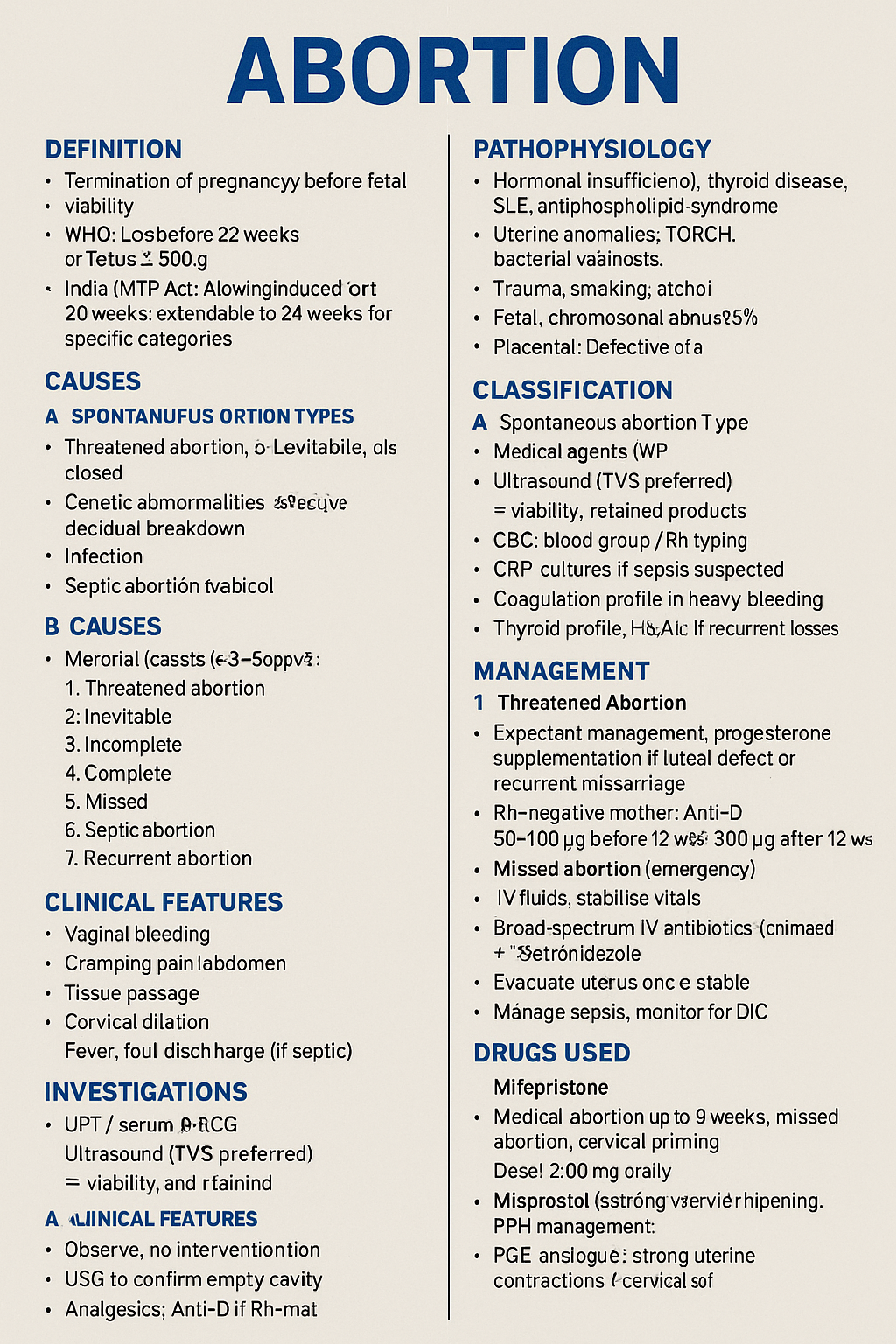
Below is the **complete, exam-ready, exhaustive medical reference on ABORTION** (MTP/ miscarriage/ induced abortion), written *only in text* as you asked. No images included.

---

# **ABORTION — COMPLETE DETAILED MEDICAL NOTES (2025)**

*(Definition → Pathophysiology → Causes → Classification → Clinical features → Investigations → Differential Diagnoses → Management → Complications → Drugs with full details)*

---

## **1. DEFINITION**

Abortion = **termination of pregnancy before fetal viability**.

* **WHO**: Loss before **22 weeks** or fetus < **500 g**.
* **India (MTP Act)**: Induced abortion allowed up to **20 weeks** (with conditions); extended to **24 weeks** for special categories.

---

## **2. PATHOPHYSIOLOGY**

Mechanisms depend on the cause:

### **Spontaneous Abortion**

* Hormonal insufficiency → ↓Progesterone → decidual breakdown → bleeding → uterine contractions → expulsion.
* Genetic abnormalities → defective embryogenesis → trophoblastic degeneration → separation.
* Infection → inflammation → prostaglandin release → cervical dilation.

### **Induced Abortion**

* Medical agents (mifepristone–misoprostol) →

* **Mifepristone**: competitive progesterone receptor blocker → decidual necrosis + cervical softening.
* **Misoprostol**: PGE1 analogue → uterine contractions → expulsion.

---

## **3. CAUSES**

### **Maternal**

* Uncontrolled diabetes, thyroid disease, SLE, antiphospholipid syndrome
* Uterine anomalies (septate uterus, fibroids)
* Infections: TORCH, bacterial vaginosis
* Trauma, smoking, alcohol

### **Fetal**

* Chromosomal abnormalities (≈50% of early losses; Trisomy 16 most common)

### **Placental**

* Defective implantation, abruption

### **Induced (elective or for maternal/ fetal indications)**

---

## **4. CLASSIFICATION**

### **A. Spontaneous Abortion Types**

1. **Threatened abortion** – bleeding, os closed, fetus alive.
2. **Inevitable** – bleeding + os open.
3. **Incomplete** – some products expelled, some retained.
4. **Complete** – all expelled, uterus empty.
5. **Missed** – fetal death but retained inside uterus.
6. **Septic abortion** – infected uterus ± sepsis.
7. **Recurrent abortion** – ≥3 consecutive losses.

### **B. Induced Abortion**

1. **Medical abortion** (mifepristone + misoprostol)
2. **Surgical abortion** – suction evacuation, D&E
3. **Second-trimester abortion** – D&E or labour induction

---

## **5. CLINICAL FEATURES**

* Vaginal bleeding
* Cramping pain lower abdomen
* Tissue passage
* Cervical dilation (variable)
* Fever, foul discharge (if septic)

---

## **6. INVESTIGATIONS**

* **UPT / serum β-hCG**
* **Ultrasound** (TVS preferred): viability, retained products
* **CBC**, **blood group / Rh typing**
* **CRP**, cultures if sepsis suspected
* **Coagulation profile** in heavy bleeding
* **Thyroid profile**, **HbA1c** if recurrent losses

---

## **7. DIFFERENTIAL DIAGNOSES**

* Ectopic pregnancy
* Molar pregnancy
* Implantation bleeding
* Cervical lesions (polyps, cancer)
* Dysfunctional uterine bleeding

---

# **8. MANAGEMENT (TYPE-WISE)**

---

## **A. Threatened Abortion**

* Expectant management
* Bed rest **NOT proven**, but minimize exertion
* Progesterone supplementation (if luteal defect or recurrent miscarriage)
* Rh-negative mother → **Anti-D** 50–100 µg before 12 wks; 300 µg after 12 wks.

---

## **B. Inevitable / Incomplete Abortion**

### **<14 weeks**

* **Medical**: Misoprostol 600–800 µg vaginal or sublingual
* **Surgical**: Manual vacuum aspiration (MVA) / suction evacuation
* Antibiotic prophylaxis (doxycycline)

### **14–24 weeks**

* Misoprostol induction regimen
* D&E by trained provider

---

## **C. Complete Abortion**

* Observe, no intervention
* USG to confirm empty cavity
* Analgesics; Anti-D if Rh– mother

---

## **D. Missed Abortion**

* **Medical**: Mifepristone 200 mg PO then misoprostol 800 µg after 24 hrs
* **Surgical**: MVA/ suction evacuation
* Anti-D if Rh–

---

## **E. Septic Abortion (Emergency)**

* IV fluids, stabilize vitals
* **Broad-spectrum IV antibiotics** (example: clindamycin + gentamicin ± metronidazole)
* Evacuate uterus once stable
* Manage sepsis, monitor for shock and DIC

---

## **F. Induced Abortion (MTP Act India)**

### **Medical Abortion (up to 9 weeks recommended)**

1. **Mifepristone 200 mg orally**
2. Followed 24–48 hrs by
**Misoprostol 800 µg** vaginal/sub-lingual/buccal
3. Repeat 400 µg after 3 hrs if needed
4. Follow-up USG at 1–2 weeks

### **Surgical Abortion**

* MVA / suction evacuation (first trimester)
* Dilation and evacuation (second trimester)

---

# **9. COMPLICATIONS**

### **Immediate**

* Hemorrhage
* Uterine perforation
* Cervical injury
* Incomplete abortion
* Anesthesia complications

### **Septic complications**

* Endometritis
* Peritonitis
* Septic shock
* MODS, DIC

### **Late**

* Asherman syndrome (intrauterine adhesions)
* Infertility
* Psychological stress

---

# **10. DRUGS USED — COMPLETE DETAILS**

---

## **1. MIFEPRISTONE**

**Indication:** Medical abortion up to 9 weeks, missed abortion, cervical priming.
**Mechanism:** Progesterone receptor antagonist → decidual breakdown; increases uterine sensitivity to prostaglandins.
**Dose:** 200 mg orally once.
**Pharmacokinetics:** Oral absorption; hepatic metabolism; t½ ≈ 18–25 hrs.
**Side Effects:** Nausea, vomiting, bleeding, cramps.
**Serious:** Heavy bleeding, incomplete abortion.
**Contraindications:** Chronic adrenal failure, long-term steroids, bleeding disorders, anticoagulants, suspected ectopic.
**Interactions:** CYP3A4 drugs, steroids (reduced efficacy).
**Monitoring:** Bleeding, vitals, follow-up USG.
**Counselling:** Bleeding expected, follow-up essential, emergency care if heavy bleeding.

---

## **2. MISOPROSTOL**

**Indication:** Medical abortion, cervical ripening, PPH management.
**Mechanism:** PGE1 analogue → strong uterine contractions + cervical softening.
**Dose:**

* Abortion: 800 µg vaginal/SL/buccal; repeat 400 µg if required.
**Pharmacokinetics:** Rapid absorption; hepatic metabolism.
**Side Effects:** Pain, diarrhea, fever, chills.
**Serious:** Uterine rupture (rare in scarred uterus).
**Contraindications:** Suspected ectopic pregnancy.
**Interactions:** None major.
**Monitoring:** Pain, bleeding.
**Counselling:** Cramping is expected; hydrate; seek help if bleeding heavy.

---

## **3. ANTIBIOTICS (SEPTIC ABORTION)**

### **Clindamycin + Gentamicin ± Metronidazole**

**Indication:** Severe pelvic infection.
**Mechanism:**

* Clindamycin → inhibits 50S ribosome
* Gentamicin → inhibits 30S ribosome
* Metronidazole → DNA damage in anaerobes
**Dosing:**
* Clindamycin 900 mg IV q8h
* Gentamicin 5–7 mg/kg IV daily
* Metronidazole 500 mg IV q8h
**Side Effects:** Nephrotoxicity, ototoxicity (gentamicin).
**Monitoring:** Renal function, vitals, WBC.

---

# **11. COUNSELLING POINTS**

* Expect bleeding for 1–2 weeks after medical abortion
* No intercourse for 1–2 weeks
* Contraception planning after abortion
* Warning signs: heavy bleeding, fever, foul discharge, severe pain
* Rhesus negative mothers need **Anti-D**

---

# **12. FOLLOW-UP**

* USG after 7–14 days to ensure complete evacuation
* Rule out anemia, infection
* Psychological support if needed

---

If you want, I can also provide:
✅ A **short exam-revision summary**,
✅ **MCQs**,
✅ **Flowcharts**,
✅ **Case-based questions**,
—all **in text only**, without images.

Just tell me **“Give MCQs”** or **“Give flowcharts”**.
HTML Versions