Home
Aneuploidy Screening in Pregnancy: First Trimester, Quadruple Test, NIPT & Soft Markers | Complete Guide 2025 ---
# ⭐ **Aneuploidy Screening in Pregnancy — Complete Obstetric Guide**
Aneuploidy = **abnormal number of chromosomes** (most clinically relevant: **Trisomy 21, 18, 13**, Turner syndrome).
Goal of screening = **identify pregnancies at increased risk** early enough to offer **diagnostic testing**.
---
# **1. Why Aneuploidy Occurs (Basic Pathophysiology)**
* **Meiotic nondisjunction** → failure of homologous chromosomes/sister chromatids to separate.
* **Common in maternal meiosis I** (age-related).
* **Trisomy 21 risk increases exponentially with maternal age**.
* Mosaicism occurs if nondisjunction happens post-zygotically.
---
# **2. High-Risk Factors**
* Advanced maternal age (≥35 yrs).
* Previous pregnancy with aneuploidy.
* Parental balanced translocation (esp. Robertsonian).
* Abnormal ultrasound markers (NT ↑, absent nasal bone, echogenic bowel, cardiac defects).
* Abnormal biochemical screening results.
---
# **3. Overview of Screening Timeline**
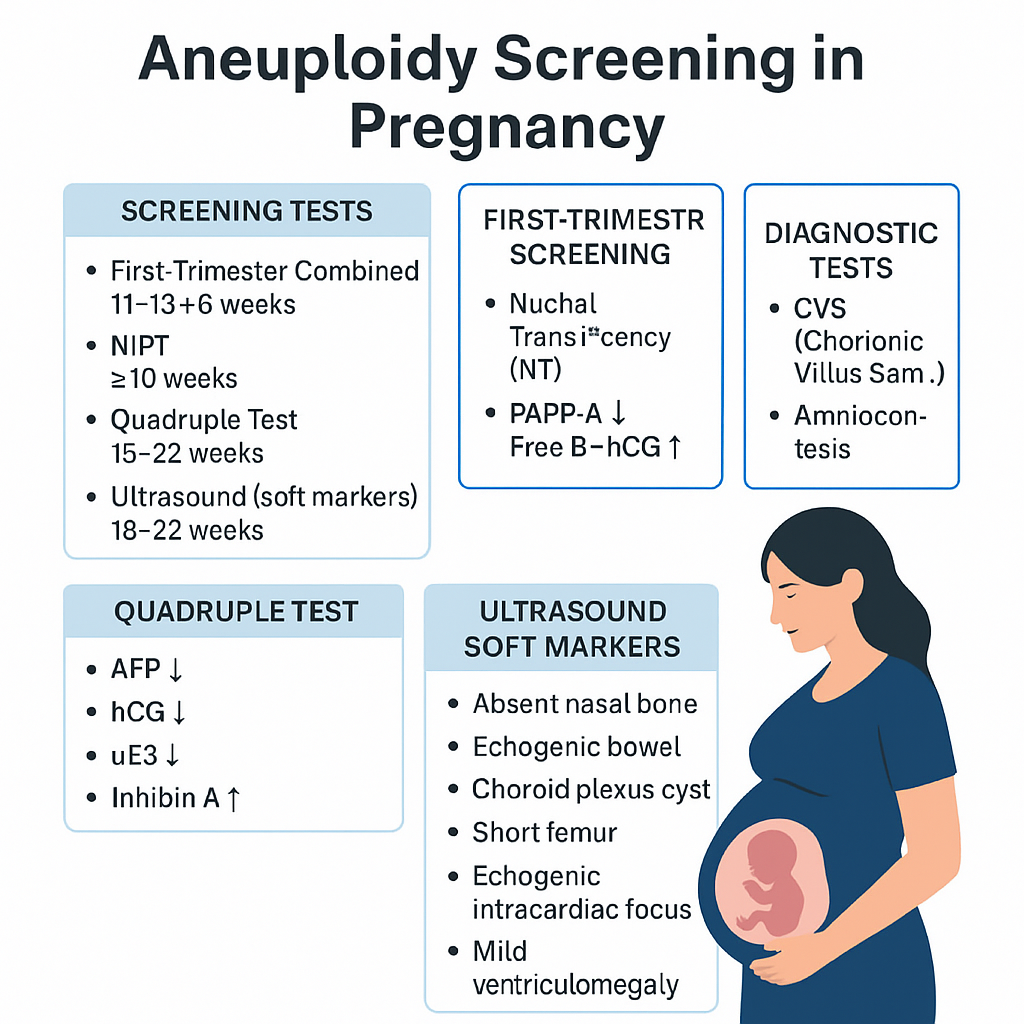
| Gestation | Test |
| ------------------- | ------------------------------------------------------------- |
| **11–13+6 weeks** | First-trimester combined screening (NT + PAPP-A + free β-hCG) |
| **10 weeks onward** | NIPT / cfDNA (highest accuracy) |
| **15–22 weeks** | Second-trimester quadruple test |
| **18–22 weeks** | Targeted anomaly scan (soft markers) |
**Screening ≠ diagnosis.**
Diagnostic tests = **CVS (10–13 wks)**, **Amniocentesis (≥15 wks)**, **FISH/karyotype/microarray**.
---
# **4. First-Trimester Screening (11–13+6 Weeks)**
## **Components**
1. **Nuchal translucency (NT):**
* Measured at CRL 45–84 mm
* **NT >3.5 mm = major risk marker**
* Increased NT → Trisomy 21/18/13, cardiac defects, Noonan syndrome, skeletal dysplasias
2. **Biochemical markers:**
* **PAPP-A ↓**: Trisomy 21/18, placental insufficiency
* **Free β-hCG ↑**: Trisomy 21
* **Free β-hCG ↓**: Trisomy 18/13
## **Detection rate:** ~85–90% for T21 when combined.
---
# **5. NIPT / cfDNA (Non-Invasive Prenatal Testing)**
* Can be done **from 10 weeks onward**.
* Analyzes **cell-free fetal DNA** in maternal blood.
* **Most accurate screening test**.
## **Detects**
* **Trisomy 21, 18, 13**
* **Sex chromosome aneuploidies** (Turner, Klinefelter)
* Microdeletions (low PPV, not recommended routinely)
## **Not diagnostic**, but:
* **Sensitivity**:
* T21 ≈ 99%
* T18 ≈ 97–98%
* T13 ≈ 92%
## **Causes of false results**
* Confined placental mosaicism
* Vanishing twin
* Maternal malignancy
* Low fetal fraction (<4%)
---
# **6. Second-Trimester Quadruple Test (15–22 Weeks)**
Markers:
* **AFP**
* **hCG**
* **uE3 (unconjugated estriol)**
* **Inhibin-A**
## **Patterns**
### **Trisomy 21**
* **AFP ↓**
* **uE3 ↓**
* **hCG ↑**
* **Inhibin-A ↑**
### **Trisomy 18**
* **AFP ↓**
* **uE3 ↓**
* **hCG ↓**
* **Inhibin-A normal**
### **Open neural tube defects**
* **AFP ↑↑**
Detection rate:
* **~75% for T21**
---
# **7. Ultrasound Soft Markers (18–22 Weeks)**
### **Major structural markers**
* Cardiac defects (AV canal) → T21
* Holoprosencephaly → T13
* Omphalocele → T18
* Diaphragmatic hernia
* Renal anomalies
### **Soft markers (non-structural)**
| Marker | Association |
| -------------------------------------- | --------------- |
| **Absent nasal bone** | T21 |
| **Echogenic intracardiac focus (EIF)** | Mild ↑ T21 risk |
| **Echogenic bowel** | T21, CMV, CF |
| **Short femur/humerus** | T21 |
| **Choroid plexus cyst** | T18 |
| **Single umbilical artery** | T18, T13 |
| **Mild ventriculomegaly** | Aneuploidy risk |
Soft markers **modify risk**, not diagnostic.
---
# **8. Integrated & Sequential Screening**
### **Integrated test**
* Combines first-trimester + second-trimester results
* Highest combined detection before NIPT
* Detection: **~94–95%**, but results available only in 2nd trimester
### **Sequential screening**
* If first-trimester is high-risk → offer NIPT/CVS
* If low-risk → continue with second trimester screening
* More practical than integrated approach
---
# **9. Diagnostic Tests (When Screening Is Positive)**
## **Chorionic Villus Sampling (CVS)**
* **10–13+6 weeks**
* Transcervical or transabdominal
* Results: karyotype, microarray
* Miscarriage risk: **~0.2–0.3%**
## **Amniocentesis**
* **≥15 weeks**
* Lower miscarriage risk: **0.1–0.2%**
## **Rapid tests**
* **FISH** (24–48 hrs): detects T21, T18, T13
* **Microarray**: detects microdeletions/duplications
---
# **10. Combined Detection Performance**
| Test | Detection rate for T21 |
| ------------------------ | ---------------------- |
| First trimester combined | 85–90% |
| Quadruple test | 75% |
| Integrated screening | 94–95% |
| **NIPT** | **>99%** |
NIPT is **preferred**, especially for high-risk pregnancies.
---
# **11. When to Offer NIPT (Indications)**
* Maternal age ≥35 yrs
* Previous trisomy pregnancy
* Abnormal ultrasound markers
* Positive biochemical screen
* IVF pregnancies (optional but recommended)
* Parental chromosomal rearrangement (screening may be inadequate → offer diagnostic test)
---
# **12. Management Algorithm (Simplified)**
### **STEP 1: First antenatal visit**
* Counsel regarding available screening methods
* Offer **NIPT** to all (optimal)
### **STEP 2: If NT scan & biochemistry done**
* **High-risk → NIPT or CVS**
* **Intermediate risk → NIPT**
* **Low risk → routine care**
### **STEP 3: Anomaly scan**
* If any major structural abnormality → **Diagnostic test (CVS/Amniocentesis)** irrespective of NIPT result
### **STEP 4: If NIPT positive**
* **Never terminate pregnancy based on NIPT alone**
* Perform **confirmatory CVS/Amniocentesis**
---
# **13. Counseling Points**
* Screening ≠ diagnosis
* Explain detection rates and false positives
* Invasive diagnostic tests carry small miscarriage risks
* A normal screen reduces but **does not eliminate** risk
* Final decision is patient-centered
---
# **14. Key Exam High-Yield Points**
* **Most sensitive screening test:** NIPT
* **Earliest diagnostic test:** CVS
* **Best time for NT scan:** 11–13+6 weeks
* **AFP ↑:** NTD, abdominal wall defects, incorrect dating
* **AFP ↓ + hCG ↑ + uE3 ↓:** Trisomy 21
* **Choroid plexus cyst:** Trisomy 18 marker
* **Absent nasal bone:** Down syndrome strongest soft marker
* **Echogenic bowel:** Trisomy 21, CMV, CF
--- HTML Versions