Antenatal Care Complete Guide 2025: Visits, Investigations, High-Risk Pregnancy, Supplements & Case Scenarios

Antenatal Care Complete Guide 2025: Visits, Investigations, High-Risk Pregnancy, Supplements & Case Scenarios
---

# ⭐ **25 Case Scenarios With Detailed Management (Antenatal Care)**

---

## **1️⃣ Missed First ANC Visit at 20 Weeks**

A 22-year-old primigravida presents for her **first antenatal visit at 20 weeks**. No prior investigations.

### **Management**

* Full baseline tests (CBC, blood group & Rh, VDRL, HIV, HBsAg, HCV, TSH, urine R/M)
* Dating scan now unreliable → use **anomaly scan** + LMP for EDD
* Counsel regarding **regular ANC visits**
* Start **IFA** + **calcium**
* **OGTT at 24–28 weeks**
* **Tdap at 27–36 weeks**

---

## **2️⃣ Severe Pallor at 28 Weeks**

G2P1 at 28 weeks: **Hb 6.8 g/dL**, symptomatic breathlessness.

### **Management**

* Classify as **severe anemia**
* **Hospital admission**
* Evaluate cause: ferritin, peripheral smear, stool for occult blood
* **Packed RBC transfusion**
* Start **parenteral iron** after stabilization
* Treat cause (e.g., deworming after 12 weeks)
* Monitor Hb every 2–4 weeks
* Plan delivery at equipped center

---

## **3️⃣ GDM Detected**

28-year-old at 26 weeks: OGTT shows **2-hr value 168 mg/dL**.

### **Management**

* Diagnose **GDM**
* Start **medical nutrition therapy** + exercise
* **Home glucose monitoring**
* If fasting >95 or PP >140 → **Insulin therapy**
* Fetal growth scan every 4 weeks
* Avoid post-dates pregnancy → deliver by **38–39 weeks**

---

## **4️⃣ High BP at 32 Weeks**

BP 148/96 mmHg + urine dipstick **1+ protein**.

### **Management**

* Diagnose **preeclampsia without severe features**
* Baseline labs: LFT, RFT, platelets, LDH, uric acid
* Start **labetalol or nifedipine**
* Fetal monitoring: NST, growth scan
* **Delivery at 37 weeks**
* Advise danger signs: headache, vision loss, epigastric pain

---

## **5️⃣ Rh-Negative Mother at 28 Weeks**

O– mother; husband is Rh+. No sensitization profile done.

### **Management**

* Perform **Indirect Coombs Test (ICT)**
* If ICT negative → give **Anti-D 300 µg at 28 weeks**
* Repeat after delivery if baby is Rh+
* Counsel about events requiring Anti-D (bleeding, ECV, amniocentesis)

---

## **6️⃣ Reduced Fetal Movements**

Woman at 34 weeks reports **decreased fetal movements**.

### **Management**

* Immediate **NST**
* If reactive → reassure + kick count chart
* If non-reactive → **BPP**, Doppler
* If Doppler abnormal → consider **delivery depending on gestational age**

---

## **7️⃣ Hyperemesis Gravidarum**

10-week pregnant woman with **severe vomiting**, ketonuria, dehydration.

### **Management**

* Admit
* IV fluids (NS/RL) + **thiamine**
* Antiemetics: **doxylamine/pyridoxine**, ondansetron
* Correct electrolytes
* Consider **steroids** if refractory
* Rule out molar pregnancy via USG + β-hCG

---

## **8️⃣ Supine Hypotension Episode**

At 30 weeks she collapses when lying flat for USG.

### **Management**

* Turn to **left lateral position**
* Reassure — benign
* Advise to avoid supine position
* Use left tilt during examinations

---

## **9️⃣ Varicose Veins With Pain**

Pregnant woman at 28 weeks with painful, swollen lower-leg veins.

### **Management**

* Leg elevation
* Compression stockings
* Avoid prolonged standing
* Paracetamol for pain
* Symptoms resolve postpartum

---

## **🔟 Leg Cramps**

Night-time cramps at 32 weeks.

### **Management**

* Stretching exercises
* Calcium + magnesium supplementation
* Warm compress
* Hydration optimization

---

## **1️⃣1️⃣ Carpal Tunnel Syndrome**

28-week pregnant woman with tingling in thumb, index & middle finger.

### **Management**

* Wrist splinting (night)
* Hand elevation
* Avoid repetitive wrist movements
* If severe → **local steroid injection**

---

## **1️⃣2️⃣ Bell’s Palsy**

Sudden left facial droop at 30 weeks.

### **Management**

* Start **Prednisolone** within 72 hours
* Lubricating eye drops + eye patch
* Reassure — most recover fully
* Differentiate from stroke (speech, limb weakness)

---

## **1️⃣3️⃣ Backache in Pregnancy**

Chronic low back pain at 24 weeks.

### **Management**

* Posture correction
* Heat therapy
* Physiotherapy/core strengthening
* Maternity support belt
* Avoid NSAIDs
* Paracetamol if needed

---

## **1️⃣4️⃣ Severe NVP (Non-Hyperemesis)**

Early pregnancy vomiting but no dehydration.

### **Management**

* Small frequent meals
* Ginger, vitamin B6
* **Doxylamine + pyridoxine**
* Avoid spicy/trigger foods
* Follow-up to ensure no progression to hyperemesis

---

## **1️⃣5️⃣ Missed Tetanus Immunisation**

Primigravida at 34 weeks has **not received TT/Tdap**.

### **Management**

* Give **Tdap 27–36 weeks** (still OK at 34 weeks)
* Single dose protects mother + baby
* No need for TT if Tdap given

---

## **1️⃣6️⃣ Teenage Pregnancy With Low BMI**

17-year-old, BMI 17.

### **Management**

* High-risk registration
* Nutritional rehabilitation (high-protein diet)
* Calcium + iron + multivitamins
* More frequent ANC visits
* Screen for anemia & infections
* Counsel about early warning signs

---

## **1️⃣7️⃣ Obese Pregnancy (BMI 34)**

High BMI detected at 12 weeks.

### **Management**

* Counsel about **excessive weight gain**
* Recommended gain: **5–9 kg**
* Early OGTT (<16 weeks)
* Low-glycemic diet
* BP monitoring for preeclampsia
* Growth scans every 4 weeks in 3rd trimester

---

## **1️⃣8️⃣ Multiple Pregnancy (Twins)**

Twin pregnancy at 18 weeks.

### **Management**

* Determine **chorionicity**
* More ANC visits
* Iron + protein supplementation
* Serial growth ultrasound every 4 weeks
* Aspirin prophylaxis for preeclampsia
* Delivery planning:

* DCDA → 37 weeks
* MCDA → 36 weeks

---

## **1️⃣9️⃣ Short Cervix at 20 Weeks**

Ultrasound: cervical length **<2.5 cm**.

### **Management**

* Start **vaginal progesterone**
* Consider **cervical cerclage** if:

* History of preterm birth
* Cervical length <2.5 cm before 24 weeks
* Lifestyle: avoid heavy lifting, intercourse restriction

---

## **2️⃣0️⃣ Recurrent UTIs**

Pregnant woman with repeated dysuria.

### **Management**

* Urine culture
* Antibiotics safe in pregnancy:

* **Nitrofurantoin** (avoid at term)
* **Cephalexin**
* Hydration
* Post-treatment repeat urine culture
* Screen for GDM if recurrent infections

---

## **2️⃣1️⃣ Rubella Non-immune**

TORCH screen shows absence of rubella IgG.

### **Management**

* Counsel: **no live vaccine in pregnancy**
* Avoid exposure
* Give **MMR postpartum**
* Future pregnancies protected

---

## **2️⃣2️⃣ Early Pregnancy Bleeding**

6-week pregnancy with spotting.

### **Management**

* Ultrasound: assess viability
* Rule out ectopic
* If threatened abortion:

* Progesterone support
* Avoid heavy activity
* Anti-D if Rh-negative

---

## **2️⃣3️⃣ Abnormal Fundal Height**

At 32 weeks: fundal height is 28 cm.

### **Management**

* Consider **IUGR**
* Ultrasound for EFW, Doppler
* Manage depending on Doppler:

* Normal → expectant
* AEDF/REDF → plan delivery
* Start kick count chart
* BP monitoring to rule out preeclampsia

---

## **2️⃣4️⃣ Polyhydramnios Detected**

AFI 28 cm at 30 weeks.

### **Management**

* Screen for **GDM**
* Detailed anomaly scan
* Fetal echocardiography
* Monitor fetal growth
* Amnioreduction if symptomatic
* Deliver at 37–38 weeks depending on cause

---

## **2️⃣5️⃣ Pregnancy With COVID-like Symptoms**

28-week woman with fever, cough, breathlessness.

### **Management**

* Test for COVID
* Assess oxygen saturation
* Safe drugs: paracetamol, azithromycin (if bacterial suspicion)
* Fetal monitoring if moderate/severe
* Anticoagulant prophylaxis if needed
* Delivery only for obstetric reasons

---


---

# ⭐ **Antenatal Care — Complete Guide**

---

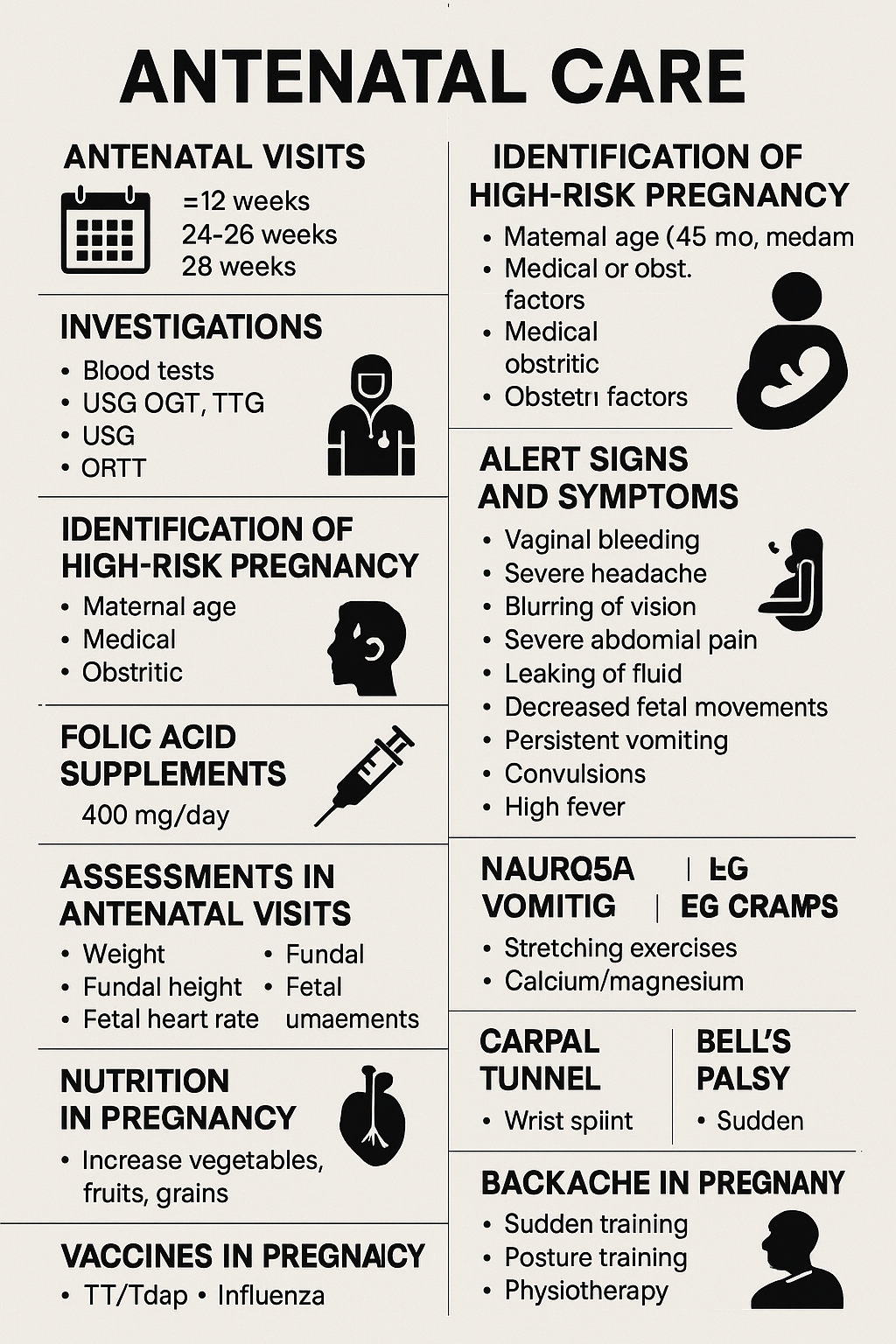
# **1. Goals of Antenatal Care (ANC)**

* Ensure **maternal and fetal well-being**
* Detect **high-risk factors early**
* Provide **counselling**, **nutrition**, **vaccination**, **supplements**
* Manage **common pregnancy complaints**
* Prepare for **safe delivery & postpartum care**

---

# **2. Antenatal Visit Schedule (WHO & India – Pradhan Mantri Surakshit Matritva Abhiyan)**

## **Minimum 8-Visit Model**

1. **≤12 weeks** – 1st visit (registration)
2. **16 weeks**
3. **20 weeks**
4. **24–26 weeks**
5. **28 weeks**
6. **32 weeks**
7. **36 weeks**
8. **38–40 weeks** (weekly till delivery)

## **Each Visit Includes**

* **General exam**: BP, weight, pallor, edema
* **Obstetric exam**: fundal height, lie, presentation, fetal heart rate
* **Risk screening**

---

# **3. Essential Laboratory Investigations**

## **First Trimester**

* **Hb, CBC**
* **Blood group + Rh typing**
* **Urine routine/microscopy**
* **VDRL/RPR (syphilis)**
* **HIV, HBsAg, HCV (triple test)**
* **Blood sugar (FBS or RBS)**
* **TSH**
* **USG dating scan (8–12 weeks)**

## **Second Trimester**

* **Anomaly scan (18–20 weeks)**
* **OGTT / GTT for GDM (24–28 weeks)**
* Repeat Hb
* Urine albumin/sugar

## **Third Trimester**

* **Growth scan (30–32 weeks)**
* **Hb/Hct**
* **Urine protein (preeclampsia screening)**

---

# **4. Identification of High-Risk Pregnancy**

## **Maternal Factors**

* Age <18 or >35
* Height <145 cm
* BMI <18.5 or >30
* Previous **cesarean**, **PPH**, **PIH**, **GDM**, stillbirth
* Grand multiparity
* Substance abuse

## **Medical High-Risk**

* Hypertension, diabetes, cardiac disease
* Epilepsy
* Thyroid disorders
* Renal disease
* Autoimmune disorders (SLE, APS)
* Severe anemia (Hb <7)

## **Obstetric High-Risk**

* Preeclampsia/eclampsia
* IUGR
* GDM
* Placenta previa/abruption
* Oligo/polyhydramnios
* Multiple pregnancy
* Rh isoimmunization

---

# **5. Danger / Alert Signs in Pregnancy**

🔴 **Immediate referral**

* Vaginal bleeding
* Severe headache, blurring of vision
* Convulsions
* Severe abdominal pain
* Leaking of fluid
* Decreased fetal movements
* Persistent vomiting
* High fever
* Severe edema / breathlessness (cardiac failure/preeclampsia)

---

# **6. Supplements in Pregnancy**

## **Folic Acid**

* **400 mcg/day** from **preconception → 12 weeks**
* **4 mg/day** if previous NTD, diabetes, antiepileptics

## **Iron**

* **60 mg elemental iron + 500 mcg folic acid daily** from **14 weeks → 6 months postpartum**

## **Calcium**

* **1–1.2 g/day** + vitamin D
* Prevents preeclampsia & bone demineralization

## **Iodine**

* **150–250 mcg/day**

## **Vitamin D**

* **600–1000 IU/day**

---

# **7. Nutrition in Pregnancy**

* Energy requirement: **+350 kcal/day**
* Protein: **+23 g/day**
* Avoid **raw eggs, unpasteurized milk, alcohol, smoking**
* Increase: green vegetables, fruits, whole grains
* Hydration: **2.5–3 L/day**

---

# **8. Vaccines in Pregnancy**

## **Recommended**

1. **TT / Tdap**

* TT at 12 weeks & 20 weeks OR
* **Tdap once between 27–36 weeks**
2. **Influenza (inactivated)** – any trimester
3. **Hepatitis B** if non-immune (0,1,6 months)

## **Contraindicated**

* MMR
* Varicella
* Live influenza (intranasal)
* HPV contraindicated during pregnancy

---

# **9. Management of Common Pregnancy Discomforts**
---

## ⭐ **Nausea & Vomiting of Pregnancy**

* Peaks at 6–12 weeks
* **Management**

* Small frequent meals, ginger, vitamin B6
* **Tab. Doxylamine + Pyridoxine** – first-line
* Avoid triggers

---

## ⭐ **Hyperemesis Gravidarum**

**Severe NVP + dehydration + ketonuria + electrolyte imbalance**

### **Management**

* Admit
* IV fluids (NS, RL) + thiamine (prevent Wernicke’s)
* Antiemetics:

* **Ondansetron**, **Metoclopramide**, **Promethazine**
* Correct electrolytes
* Severe resistant cases → **steroids**

---

## ⭐ **Supine Hypotension Syndrome**

* Pregnant uterus compresses **IVC** → dizziness, hypotension when lying supine

### **Management**

* Left lateral position
* Avoid lying flat after 20 weeks

---

## ⭐ **Varicose Veins in Pregnancy**

* Progesterone + increased venous pressure

### **Management**

* Leg elevation
* Compression stockings
* Avoid prolonged standing

---

## ⭐ **Leg Cramps**

* Due to ↓ calcium/magnesium

### **Management**

* Stretching exercises
* Calcium + magnesium supplements
* Warm compress

---

## ⭐ **Carpal Tunnel Syndrome**

* Median nerve compression due to fluid retention

### **Management**

* Wrist splinting
* Avoid repetitive activities
* NSAIDs avoided; **steroids** only if severe

---

## ⭐ **Bell’s Palsy in Pregnancy**

* Increased risk in 3rd trimester

### **Management**

* **Prednisolone** early
* Eye protection (lubricants, eye patch)
* Prognosis good

---

## ⭐ **Backache in Pregnancy**

* Due to lordosis, ligament laxity

### **Management**

* Posture training
* Heat therapy
* Physiotherapy
* Avoid heavy lifting
* Maternity belt support

---

# **10. Assessments During Antenatal Visits**

* **Weight gain:** total **11–16 kg** (normal BMI)
* **Fundal height:**

* 20 weeks → umbilicus
* 36 weeks → xiphisternum
* **Fetal heart rate (FHR):** 110–160 bpm
* **BP monitoring:** screen for PIH
* **Urine albumin:** preeclampsia screening
* **Fetal movements:** kick count after 28 weeks
* **Ultrasound:** growth + Doppler in high-risk cases

---

# **11. Birth Preparedness Counselling**

* Danger signs
* Blood donor identification
* Delivery planning (institutional delivery)
* Breastfeeding counselling

---

HTML Versions