Antepartum Fetal Monitoring: Indications, NST, Biophysical Profile, Modified BPP & Vibroacoustic Test | Complete Obstetrics Guide 2025

Antepartum Fetal Monitoring: Indications, NST, Biophysical Profile, Modified BPP & Vibroacoustic Test | Complete Obstetrics Guide 2025
Below is your **complete, exam-oriented, fully detailed master note** on **Antepartum Fetal Monitoring** covering:

✔ Indications
✔ Maternal fetal movement count
✔ Non-Stress Test (NST)
✔ Biophysical Profile (BPP/Manning Score)
✔ Vibroacoustic Stimulation Test (VAST)
✔ Modified Biophysical Profile (mBPP)
✔ Interpretation + Management

---

# ⭐ **ANTEPARTUM FETAL MONITORING — COMPLETE HIGH-YIELD REFERENCE (NEET PG / INI-CET)**

Antepartum fetal surveillance aims to detect **early fetal hypoxia** to prevent stillbirth, reduce perinatal morbidity, and guide timing of delivery. It assesses **placental function**, **oxygenation**, **neurological integrity**, and **fetal compensatory mechanisms**.

---

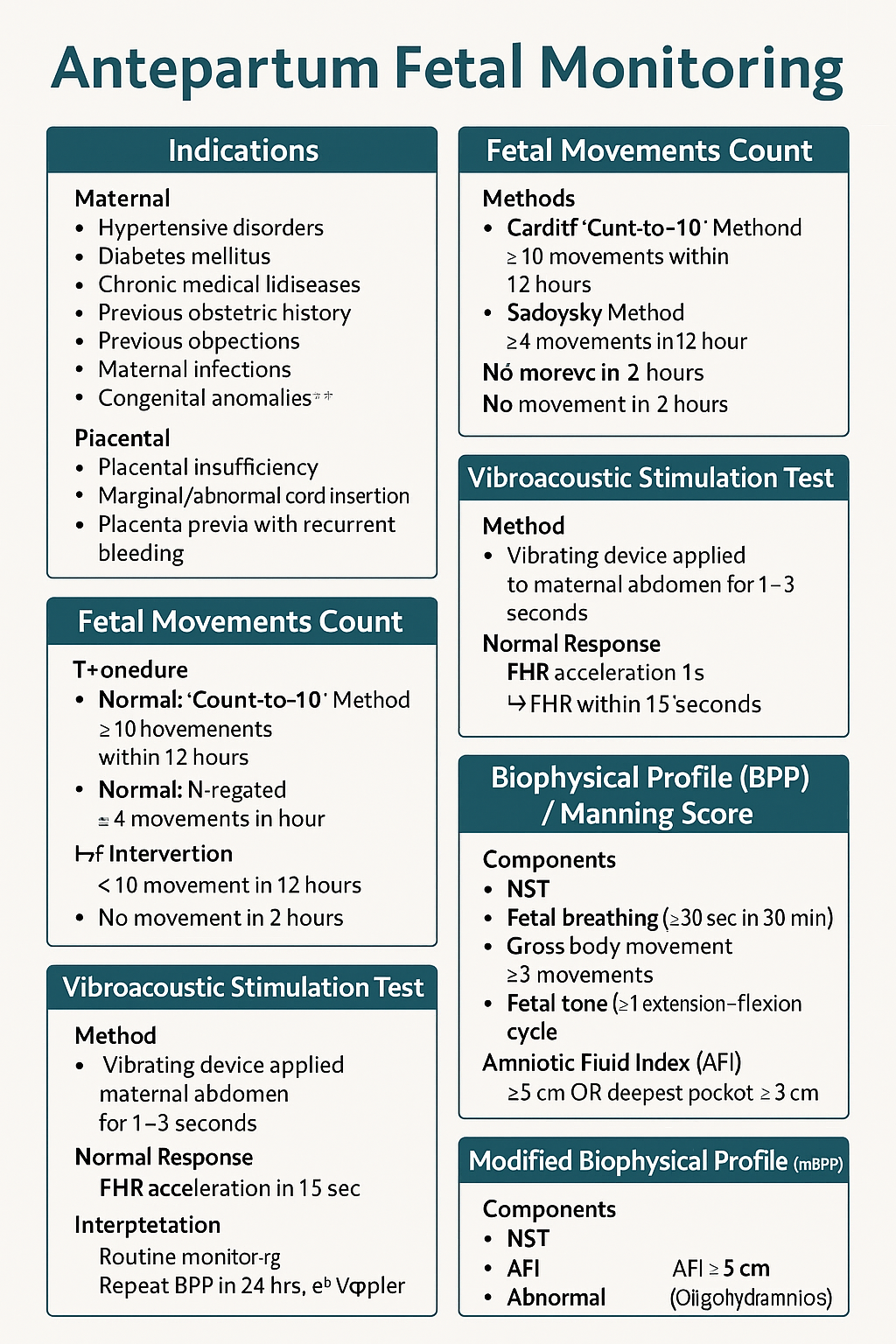
# **1️⃣ Indications for Antepartum Fetal Monitoring**

### **A. Maternal Indications**

* **Hypertensive disorders:** Gestational HTN, preeclampsia, eclampsia
* **Diabetes mellitus:** GDM requiring insulin/OADs, pre-gestational DM
* **Chronic medical diseases:**

* Chronic hypertension
* Renal disease
* Autoimmune disease (SLE, APLA syndrome)
* Cardiac disease
* Thyroid disease with complications
* **Previous obstetric history:**

* Previous stillbirth
* Previous IUGR baby
* Previous neonatal death
* Isoimmunization/Rh alloimmunization
* **Maternal infections:** TORCH with fetal involvement
* **Advanced maternal age (>35)**
* **Post-dated pregnancy (>40 weeks)**

### **B. Fetal Indications**

* **Decreased fetal movements**
* **IUGR (Symmetric/Asymmetric)**
* **Oligohydramnios / Polyhydramnios**
* **Multiple pregnancy with complications**
* **Fetal anemia / hydrops**
* **Congenital anomalies**

### **C. Placental Indications**

* Placental insufficiency
* Marginal/Abnormal cord insertion
* Placenta previa with recurrent bleeding

---

# **2️⃣ Fetal Movement Count (FMC / Kick Count)**

Fetal movements reflect fetal well-being (neurological + metabolic status).

### **Methods**

### **A. Cardiff Count-to-10 Method**

* Mother records movements daily.
* **Normal:** 10 movements within 12 hours.

### **B. Sadovsky Method**

* Count movements for 1 hour after meals.
* **Normal:** ≥4 movements/hour.

### **When to worry?**

* **<10 movements in 12 hours**
* **<4 movements in 1 hour**
* **No movement in 2 hours** → urgent evaluation (NST/BPP)

### **Management of Decreased Fetal Movements**

1. Immediate **NST**
2. If NST non-reactive → **BPP**
3. If BPP equivocal → **Doppler studies**
4. If evidence of fetal compromise → **Delivery based on GA**

---

# **3️⃣ Non-Stress Test (NST)**

NST measures **fetal heart rate accelerations** in response to fetal movements via cardiotocography.

### **Procedure**

* Done after **28–32 weeks** (mature autonomic nervous system).
* Duration: **20 minutes** (extend to 40 minutes if needed).

---

## **Interpretation (Reactive vs Non-Reactive)**

### ✔ **Reactive NST (Normal)**

* **≥2 accelerations** in 20 minutes
* Acceleration criteria:

* **≥15 bpm for ≥15 sec** (≥32 weeks)
* **≥10 bpm for ≥10 sec** (<32 weeks)

### ✔ **Non-Reactive NST**

* <2 accelerations in 40 minutes
* Suggests fetal sleep cycle, hypoxia, CNS depression.

### **Causes of Non-Reactive NST**

* Fetal sleep
* Maternal drug intake (MgSO₄, opioids, sedatives)
* Hypoxia
* Prematurity
* Congenital anomalies

### **Next Steps in Non-Reactive NST**

* Vibroacoustic stimulation test
* BPP
* Contraction stress test (rarely used today)
* Doppler studies

---

# **4️⃣ Vibroacoustic Stimulation Test (VAST)**

Used to differentiate fetal sleep from hypoxia in non-reactive NST.

### **Method**

* A vibrating device (artificial larynx) applied to maternal abdomen for **1–3 seconds**.

### **Normal Response**

* FHR acceleration within **15 seconds**
* Converts non-reactive NST → **reactive**

### **Significance**

* High negative predictive value
* Reduces need for BPP

---

# **5️⃣ Biophysical Profile (BPP) / Manning Score**

Combines **NST + ultrasound parameters** assessing fetal CNS integrity + oxygenation.

### **Components (Total 10 points)**

Each gets **2 = normal**, **0 = abnormal**

| Component | Normal Criteria (2 points) |
| ------------------------------ | --------------------------------- |
| **NST** | Reactive |
| **Fetal breathing** | ≥30 sec in 30 min |
| **Gross body movement** | ≥3 movements |
| **Fetal tone** | ≥1 extension–flexion cycle |
| **Amniotic Fluid Index (AFI)** | AFI ≥5 cm OR deepest pocket ≥2 cm |

---

## **Scoring & Interpretation**

| Score | Interpretation | Management |
| -------- | -------------- | ------------------------------------------- |
| **8–10** | Normal | Routine monitoring |
| **6** | Equivocal | Repeat BPP in 24 hrs; evaluate Doppler |
| **4** | Abnormal | Risk of fetal hypoxia → Delivery if ≥34 wks |
| **0–2** | Severe hypoxia | Immediate delivery |

---

# **6️⃣ Modified Biophysical Profile (mBPP)**

Simplified & widely used.

### **Components**

1. **NST**
2. **AFI (Amniotic Fluid Index)**

### **Interpretation**

* **Normal:** Reactive NST + AFI ≥5 cm
* **Abnormal:**

* Non-reactive NST
* AFI <5 cm (Oligohydramnios) → placental insufficiency

### **Management**

* If abnormal mBPP → full BPP or Doppler; consider delivery based on GA.

---

# **7️⃣ Contraction Stress Test (OBSOLETE mostly)**

Assesses fetal response to **uterine contractions** → risk of late decelerations.

Rarely done due to risk + availability of Doppler and BPP.

---

# **8️⃣ Putting It All Together — Management Algorithm**

### **Decreased fetal movements →**

1. **NST**
2. If reactive → reassure
3. If non-reactive → repeat + VAST
4. If still non-reactive → BPP
5. * **BPP ≤4** → Delivery
* **BPP 6** → Repeat in 24 hrs
* **BPP 8–10** → Continue routine follow-ups
6. Assess **AFI, Doppler, maternal condition**

---

# **9️⃣ Important Clinical Correlations**

### **NST becomes abnormal earliest in fetal hypoxia**

CNS activity reduces → loss of accelerations.

### **BPP components lost in sequence during hypoxia (Late → Early loss)**

1. **NST**
2. **Fetal breathing**
3. **Gross movement**
4. **Fetal tone** (last to disappear)
5. **AFI reduced** from chronic utero-placental insufficiency

### **AFI is chronic marker**; NST is acute marker.

---

# ⭐ **HIGH-YIELD VALUES (MUST REVISE)**

* Reactive NST: **≥2 accelerations** (15 × 15)
* Tone: 1 flexion–extension
* Breathing: ≥1 episode ≥30 sec
* Movement: ≥3 body movements
* AFI: Normal ≥5 cm
* Modified BPP = NST + AFI
* Sleep cycle: **20–40 min** → extend NST to 40 min

---

If you'd like, I can also generate:

✅ **Hard MCQs with explanations (HTML + CSS + JS exam mode)**
✅ **SEO-optimized title + meta description**
✅ **Case scenarios**
✅ **Infographic/diagram image**

Just tell me **what you want next.**
Below are **25 high-yield, clinically realistic, exam-oriented case scenarios** on **Antepartum Fetal Monitoring**, each with **stepwise management** exactly as required for NEET PG / INI-CET level.

---

# ⭐ **25 CASE SCENARIOS WITH DETAILED MANAGEMENT**

*(Antepartum Fetal Surveillance: FMC, NST, BPP, VAST, mBPP)*

---

# **1️⃣ Case Scenario – Decreased Fetal Movements at 34 Weeks**

A 28-year-old G2P1 at 34 weeks reports **no fetal movements for 8 hours**.

### **Management**

1. Immediate **NST**
2. If **reactive** → reassure, daily kick count
3. If **non-reactive** → extend to 40 min
4. If still non-reactive → **VAST**
5. If remains non-reactive → **BPP**
6. * **BPP ≥8** → Follow-up
* **BPP ≤4** → Deliver based on GA

---

# **2️⃣ Case Scenario – Non-Reactive NST in a Diabetic Mother**

GDM on insulin at 36 weeks undergoes NST → **non-reactive** after 40 minutes.

### **Management**

1. Perform **VAST**
2. If reactive → repeat NST in 1 week
3. If still non-reactive → **Full BPP**
4. If BPP score **≤4** → Plan delivery
5. Assess **AFI & Doppler** for placental insufficiency

---

# **3️⃣ Case Scenario – Oligohydramnios with IUGR**

30-year-old at 32 weeks with **AFI = 4 cm**, EFW <10th percentile.

### **Management**

1. Start **modified BPP (NST + AFI)**
2. Daily NST
3. Doppler: **Umbilical artery S/D ratio**
4. If AEDF/REDF → **Immediate delivery**
5. If NST non-reactive → full BPP
6. Steroids if <34 weeks

---

# **4️⃣ Case – Post-Dated Pregnancy (41 Weeks)**

Patient at 41+2 weeks shows decreased fetal movement.

### **Management**

1. **NST + AFI**
2. If NST reactive & AFI normal → induce labour within 24–48 hrs
3. If NST non-reactive → BPP
4. BPP ≤6 → Deliver
5. Continuous intrapartum monitoring

---

# **5️⃣ Case – Preeclampsia with Severe Features**

32 weeks, BP 160/110, proteinuria +++, fetus active.

### **Management**

1. Daily **NST**
2. Twice-weekly **BPP**
3. Doppler (UA + MCA) weekly
4. Magnesium sulfate for seizure prophylaxis
5. Deliver at 34 weeks or earlier if fetal compromise

---

# **6️⃣ Case – Chronic Hypertension with Reduced Movements**

35-year-old with chronic HTN reports <4 kicks in 1 hr.

### **Management**

1. Immediate **NST**
2. If non-reactive → BPP
3. If AFI <5 → suspect placental insufficiency
4. Admit, daily surveillance
5. Deliver if BPP ≤4 or Doppler abnormal

---

# **7️⃣ Case – IUGR with Normal NST**

29 weeks, IUGR but **reactive NST**.

### **Management**

1. Continue **twice-weekly NST**
2. Weekly Doppler (UA/ MCA/ CPR ratio)
3. Growth scan every 2 weeks
4. Deliver if Doppler deteriorates or NST becomes abnormal

---

# **8️⃣ Case – Polyhydramnios with GDM**

30-year-old with polyhydramnios, NST reactive.

### **Management**

1. Twice-weekly NST
2. AFI monitoring
3. Doppler weekly
4. Induce at 38–39 weeks
5. Prepare for shoulder dystocia risk

---

# **9️⃣ Case – Decreased Fetal Movement in Obese Mother**

NST shows **baseline variability minimal**.

### **Management**

1. Rule out maternal meds, sleep cycle
2. Extend NST + VAST
3. If still abnormal → BPP
4. Deliver if BPP ≤4

---

# **🔟 Case – Rh-Isoimmunization**

28 weeks, MCA PSV >1.5 MOM (fetal anemia suspected).

### **Management**

1. Immediate **NST**
2. If non-reactive → BPP
3. Plan **intrauterine transfusion**
4. After IUT: Daily NST

---

# **1️⃣1️⃣ Case – Twin Pregnancy with Growth Discordance**

NST non-reactive for smaller twin.

### **Management**

1. VAST
2. If still non-reactive → BPP for each twin
3. Doppler UA/MCA/ Ductus venosus
4. Deliver if evidence of compromise

---

# **1️⃣2️⃣ Case – Maternal Hypoglycemia Before NST**

NST shows no accelerations.

### **Management**

1. Give oral glucose
2. Repeat NST
3. If becomes reactive → normal
4. If persistently non-reactive → VAST → BPP

---

# **1️⃣3️⃣ Case – Placental Abruption Suspicion**

Pain + bleeding + reduced movements.

### **Management**

1. **Immediate NST**
2. If late decelerations / bradycardia → **Immediate delivery**
3. Stabilize mother

---

# **1️⃣4️⃣ Case – COVID Positive Mother with Decreased Movements**

NST non-reactive.

### **Management**

1. Rule out maternal fever, hypoxia
2. Oxygen + hydration
3. VAST
4. If still non-reactive → BPP
5. Deliver if fetal compromise

---

# **1️⃣5️⃣ Case – Smoking Mother with IUGR**

NST shows decreased variability.

### **Management**

1. VAST
2. BPP
3. Doppler UA
4. Nicotine cessation + fetal surveillance every 2–3 days

---

# **1️⃣6️⃣ Case – Absent Fetal Breathing on BPP**

BPP = 6/10 (breathing absent).

### **Management**

1. Repeat BPP in 24 hrs
2. If repeat BPP ≤6 → Deliver
3. Continuous NST monitoring

---

# **1️⃣7️⃣ Case – Low AFI but Reactive NST**

AFI = 4 cm at 37 weeks.

### **Management**

1. Diagnose **oligohydramnios**
2. Admit, hydration
3. Modified BPP daily
4. Deliver at 37–38 weeks

---

# **1️⃣8️⃣ Case – Maternal Seizure on MgSO₄**

NST shows minimal variability (drug effect).

### **Management**

1. Continue monitoring
2. Do not interpret variability during MgSO₄ therapy
3. Use **BPP** instead of NST

---

# **1️⃣9️⃣ Case – Poorly Controlled Diabetes**

36 weeks, polyhydramnios + macrosomia.

### **Management**

1. NST every 2–3 days
2. Weekly BPP
3. Deliver at 38 weeks
4. Prepare for shoulder dystocia

---

# **2️⃣0️⃣ Case – Maternal Dehydration**

NST non-reactive.

### **Management**

1. Give IV fluids
2. Repeat NST
3. If reactive → dehydration cause
4. If persists → BPP

---

# **2️⃣1️⃣ Case – Postpartum Hemorrhage Risk Mother**

Placenta previa major.

### **Management**

1. Weekly NST
2. BPP if NST abnormal
3. Plan elective C-section at 36–37 weeks

---

# **2️⃣2️⃣ Case – Fetal Tachycardia**

FHR 170 bpm in NST.

### **Management**

1. Exclude maternal fever, dehydration, drugs
2. Treat maternal cause
3. If persists → BPP + Doppler
4. Consider delivery if fetal compromise

---

# **2️⃣3️⃣ Case – Mother on Sedatives**

NST non-reactive.

### **Management**

1. Document medication effect
2. Perform BPP instead of repeating NST
3. Reassure if BPP normal

---

# **2️⃣4️⃣ Case – Sudden IUD Suspicion**

No FHR detected in NST.

### **Management**

1. Confirm with ultrasound
2. Evaluate cause (abruption, cord accident)
3. Manage according to GA and maternal stability

---

# **2️⃣5️⃣ Case – Preterm (<32 Weeks) Non-Reactive NST**

At 30 weeks, NST non-reactive.

### **Management**

1. Extend NST to 40 min
2. Apply VAST
3. If still non-reactive → BPP
4. If BPP ≤4 → Deliver after steroid cover
5. If BPP normal → prematurity likely cause

---

# ⭐ If you want, I can also provide:

✅ **25 Hard MCQs (HTML + CSS + JS exam mode)**
✅ **Infographic image**
✅ **Full HTML post with SEO + JSON-LD schema**
Just tell me!

HTML Versions