Home
Heart Disease in Pregnancy: Causes, Risks, Management & 20 Case-Based MCQs (With Answers & Explanations) Below is a **complete, exam-ready, concise-but-exhaustive reference** for **Heart Disease in Pregnancy** — covering definition, physiology, classification, clinical features, investigations, management (stepwise), drug details, labor/delivery planning, postpartum care, and contraindications.
---
# **Heart Disease in Pregnancy – Complete Overview**


---
## **1. Definition**
Heart disease in pregnancy refers to **pre-existing cardiac disorders** (congenital or acquired) or **pregnancy-induced cardiac dysfunction** (e.g., peripartum cardiomyopathy) that complicate pregnancy, labor, or postpartum period.
---
## **2. Why Pregnancy Worsens Heart Disease (Physiological Changes)**
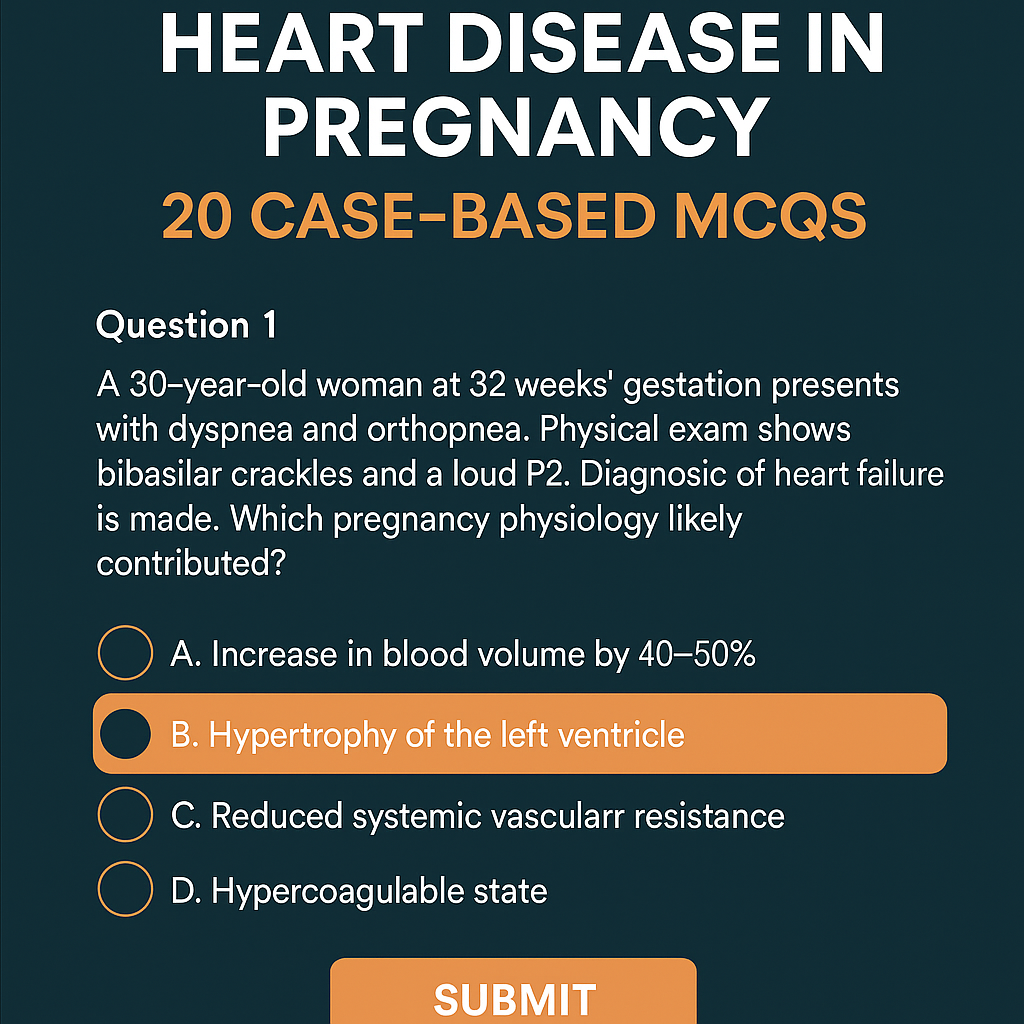
Pregnancy causes major hemodynamic changes that peak at **28–32 weeks**:
* **↑ Blood volume by 40–50%**
* **↑ Cardiac output by 30–50%**
* **↑ Heart rate by 10–20 bpm**
* **↓ Systemic vascular resistance**
* **Hypercoagulable state**
* **During labor:** CO ↑ 20–30% more
* **Immediately postpartum:** Autotransfusion ↑ CO up to 80%
These changes may **unmask latent heart disease** or **worsen existing cardiac failure**.
---
## **3. Types of Heart Diseases Seen in Pregnancy**
### **A. Congenital Heart Disease (CHD)**
* Atrial septal defect (ASD)
* Ventricular septal defect (VSD)
* Patent ductus arteriosus (PDA)
* Tetralogy of Fallot (repaired/unrepaired)
* Eisenmenger syndrome (very high-risk)
### **B. Acquired Heart Disease**
* Rheumatic heart disease
* Mitral stenosis (most common serious lesion in pregnancy)
* Mitral regurgitation
* Aortic stenosis
* Cardiomyopathies
* **Peripartum cardiomyopathy**
* Ischemic heart disease
* Arrhythmias
* Hypertensive heart disease
---
## **4. WHO Classification of Maternal Cardiovascular Risk**
### **WHO Class I – Low Risk**
* Small ASD/VSD
* PDA
* Mitral valve prolapse
* Successfully repaired simple CHD
### **WHO Class II – Moderate Risk**
* Unrepaired ASD/VSD
* Repaired TOF
* Mild LV dysfunction
### **WHO Class III – High Risk**
* Mechanical valves
* Cyanotic congenital heart disease
* Moderate LV dysfunction
* Previous peripartum cardiomyopathy with normal EF now
### **WHO Class IV – Extremely High Risk (Pregnancy Contraindicated)**
* **Pulmonary hypertension / Eisenmenger syndrome**
* **Severe LV dysfunction (EF < 30%)**
* **Severe mitral stenosis or aortic stenosis**
* **Marfan syndrome with aorta > 45 mm**
* **Previous peripartum cardiomyopathy with persistent dysfunction**
---
## **5. Clinical Features**
### **Symptoms**
* Dyspnea (especially NYHA III–IV)
* Orthopnea / PND
* Fatigue
* Palpitations
* Chest pain
* Syncope
### **Warning Features of Cardiac Decompensation**
* Dyspnea at rest
* Hemoptysis
* Cyanosis
* Loud P2 / RV heave
* Basal crepitations
* New arrhythmias
---
## **6. Investigations**
### **Basic**
* CBC
* ECG
* **Echocardiography – Most important**
* BNP (optional)
### **Advanced**
* Cardiac MRI (safe without gadolinium)
* Holter monitoring
* Exercise testing (pre-pregnancy only)
### **Avoid**
* CT angiography unless life-saving
* ACE inhibitors / ARBs history to be checked
---
## **7. Complications**
* **Maternal:** Heart failure, arrhythmias, thromboembolism, endocarditis, cardiac arrest
* **Fetal:** IUGR, preterm birth, fetal hypoxia, congenital heart disease (3–5% risk)
---
# **8. Management of Heart Disease in Pregnancy (Stepwise)**


---
## **A. Preconception Counselling**
* Risk assessment + WHO classification
* Optimize cardiac status (e.g., balloon valvotomy for MS)
* Stop teratogenic drugs (ACE inhibitors, ARBs, statins, warfarin if possible)
---
## **B. Antenatal Management**
### **1. Lifestyle**
* Adequate rest
* Left lateral position
* Avoid anemia (treat aggressively)
* Avoid excessive weight gain
* Salt restriction if HF symptoms
### **2. Drugs Used**
Below are the major drug classes **with indications, mechanism, dosing, adverse effects, contraindications, interactions, and counselling.**
---
## **i. Diuretics (Furosemide)**
**Indication:** Heart failure, pulmonary edema
**MOA:** Loop diuretic → inhibits Na-K-2Cl in loop of Henle
**Dose:** 20–40 mg PO/IV, repeat as required
**PK:** Rapid onset, renal excretion
**AEs:** Hypokalemia, dehydration
**Contra:** Severe electrolyte imbalance
**Interactions:** Digoxin ↑ toxicity if hypokalemia
**Counselling:** Monitor weight, urine output, electrolytes
---
## **ii. Beta-blockers (Metoprolol preferred)**
**Indication:** Rate control, arrhythmias, ischemic heart disease
**MOA:** Blocks β1 receptors → ↓ HR & contractility
**Dose:** 25–100 mg/day
**AEs:** IUGR (minimal), bradycardia
**Contra:** Severe asthma
**Interactions:** Calcium channel blockers → heart block risk
**Counselling:** Do not stop suddenly
---
## **iii. Anticoagulants**
### **a. LMWH (Enoxaparin) – Preferred**
**Indication:** Mechanical valves, AF, thromboembolism
**MOA:** Enhances antithrombin III → inhibits Xa
**Dose:** 1 mg/kg twice daily
**Monitoring:** Anti-Xa levels
**AEs:** Bleeding
**Contra:** Active bleeding
### **b. Warfarin – Teratogenic (avoid 6–12 weeks)**
Used only when valve thrombosis risk is very high.
---
## **iv. Vasodilators (Hydralazine, Nitrates)**
**Indication:** HF with hypertension
**AEs:** Headache, hypotension
---
## **v. Digoxin**
**Indication:** HF with atrial fibrillation
**MOA:** Na-K ATPase inhibition → ↑ Ca → ↑ contractility
**Dose:** 0.125–0.25 mg daily
**AEs:** Toxicity (nausea, vision changes)
**Monitor:** Serum levels
---
## **Drugs Contraindicated in Pregnancy**
* **ACE inhibitors / ARBs** → renal failure, skull defects
* **Amiodarone** → fetal thyroid dysfunction
* **Warfarin (first trimester)** unless essential
* **Statins**
---
## **C. Follow-up Schedule**
* Monthly (WHO I–II)
* Fortnightly (WHO III)
* Weekly (WHO IV — pregnancy discouraged)
---
# **9. Labor and Delivery Management**


### **Preferred Mode:** **Vaginal delivery with epidural anesthesia**
### **Indications for Caesarean Section**
* Severe aortic stenosis
* Marfan with aortic root dilation
* Eisenmenger
* Severe HF
* Anticoagulation not stopped
### **Intrapartum Measures**
* Continuous ECG + pulse oximetry
* Avoid fluid overload
* Slow, assisted second stage (forceps/vacuum)
### **Anesthesia**
* Epidural preferred
* Avoid general anesthesia (↑ cardiac stress)
---
# **10. Postpartum Care**
* Highest risk of heart failure in **first 24–72 hours**
* Gradual mobilization
* Restart anticoagulation after 6 hours (if needed)
* Contraception counselling
* **Avoid estrogen pills**
* Prefer: IUCD, progestin-only methods
---
# **11. High-Risk Specific Conditions**
## **A. Mitral Stenosis**
* Most dangerous RHD lesion in pregnancy
* Tachycardia → ↑ LA pressure → pulmonary edema
* Management: β-blockers + diuretics
* Balloon valvotomy if severe
---
## **B. Eisenmenger Syndrome**
* **Pregnancy contraindicated (WHO IV)**
* Maternal mortality 30–50%
* No effective treatment → counselling for termination
---
## **C. Peripartum Cardiomyopathy**
* Heart failure in last month of pregnancy or 5 months postpartum
* EF < 45%
* Treatment:
* Diuretics
* Beta-blockers
* Bromocriptine (stops prolactin → improves function)
* Avoid future pregnancy if EF not normalized
---
# **12. Fetal Risks**
* Prematurity
* Growth restriction
* Neonatal asphyxia
* Congenital heart disease (if mother has CHD)
---
# **13. Key Prevention Strategies**
* Early diagnosis
* Control anemia
* Avoid excessive fluids
* Use cardiac medications judiciously
* Multidisciplinary care (obstetrician + cardiologist)
---
# **Would you like a SEO-optimized title & description for this topic, or a high-ranking blog article version?** HTML Versions