Intrapartum Fetal Monitoring: CTG Interpretation, Decelerations, Sinusoidal Pattern & Complete Management Guide 2025

Intrapartum Fetal Monitoring: CTG Interpretation, Decelerations, Sinusoidal Pattern & Complete Management Guide 2025
Below are **30 detailed intrapartum fetal monitoring case scenarios with complete management**, written in **NEET PG / INI-CET exam style**.
Each scenario includes **clinical context → CTG finding → diagnosis → step-wise management**.

---

# ✅ **30 CASE SCENARIOS WITH DETAILED MANAGEMENT (Intrapartum Fetal Monitoring)**

---

## **1️⃣ Case — Late Decelerations in a Preeclamptic Mother**

A 25-year-old primigravida, 4 cm dilated, on oxytocin. CTG shows **recurrent late decelerations**, baseline 150, variability <5 bpm.

### **Diagnosis**

Uteroplacental insufficiency from **preeclampsia + hyperstimulation**.

### **Management**

1. Stop oxytocin
2. Left lateral position
3. IV fluids
4. If contraction frequency >5/10 min → **tocolysis (terbutaline 0.25 mg SC)**
5. If no improvement → **FBS**
6. If pH <7.20 or tracing deteriorates → **Emergency LSCS**

---

## **2️⃣ Case — Variable Decelerations with Oligohydramnios**

G2P1, term labor, CTG shows **variable decelerations with shoulders**, adequate variability.

### **Diagnosis**

Cord compression due to oligohydramnios.

### **Management**

1. Maternal repositioning
2. Amnioinfusion
3. Continue labor if variability normal
4. If severe recurrent variables + loss of variability → expedite delivery

---

## **3️⃣ Case — Sinusoidal Pattern**

Rh-negative woman, fetus 38 weeks. CTG: **true sinusoidal pattern**.

### **Diagnosis**

Severe fetal anemia.

### **Management**

1. Immediate evaluation (Kleihauer test, ultrasound MCA Doppler if time permits)
2. **Emergency LSCS**
3. Prepare NICU for transfusion

---

## **4️⃣ Case — Prolonged Deceleration from Cord Prolapse**

During vaginal exam, a loop of cord felt. CTG shows **bradycardia at 80 bpm** for 4 minutes.

### **Management**

1. Lift presenting part manually
2. Knee–chest position
3. Call for emergency LSCS
4. Warm sterile saline-soaked gauze to prevent vasospasm
5. Deliver within **<30 minutes**

---

## **5️⃣ Case — Tachysystole-Induced Late Decelerations**

Oxytocin infusion running, contractions 6/10 min. CTG: recurrent late decels.

### **Management**

1. Stop oxytocin immediately
2. Terbutaline 0.25 mg SC
3. Lateral position
4. Reassess
5. If persists → expedite delivery

---

## **6️⃣ Case — Minimal Variability for 50 Minutes**

Primigravida in active labor. CTG: baseline 140, variability <5 bpm for 50 min, no decels.

### **Diagnosis**

Non-reassuring CTG, possibly fetal sleep or medication effect.

### **Management**

1. Scalp stimulation
2. If acceleration present → reassuring
3. If absent → FBS or continuous monitoring
4. Continue labor if other parameters normal

---

## **7️⃣ Case — Meconium-Stained Liquor with Abnormal CTG**

Thick meconium + variable decels + reduced variability.

### **Management**

1. Intrauterine resuscitation
2. Amnioinfusion (if available)
3. Prepare for operative delivery
4. NICU standby for Meconium Aspiration Syndrome

---

## **8️⃣ Case — Prolonged Deceleration After Epidural**

Immediately after epidural, FHR drops to 90 bpm for 3 minutes.

### **Diagnosis**

Maternal hypotension causing decreased uteroplacental flow.

### **Management**

1. Left lateral position
2. IV fluid bolus
3. Vasopressor (phenylephrine preferred)
4. If persists beyond 5 minutes → consider LSCS

---

## **9️⃣ Case — Fetal Tachycardia with Maternal Fever**

CTG shows FHR 180 bpm, moderate variability; maternal temp 101°F.

### **Diagnosis**

Chorioamnionitis.

### **Management**

1. Broad-spectrum antibiotics
2. Acetaminophen
3. Expedite delivery (not LSCS solely for fever)
4. Avoid prolonged labor

---

## **🔟 Case — Arrest of Descent + Late Decelerations**

Second stage, fully dilated, prolonged pushing, late decels appear.

### **Management**

1. Check for instrumental eligibility
2. **Forceps or vacuum** if head low
3. If not eligible → emergency LSCS

---

## **1️⃣1️⃣ Case — Recurrent Severe Variable Decelerations**

CTG: variable decels dropping to 70 bpm for 60–90 sec.

### **Management**

1. Lateral positioning
2. Amnioinfusion
3. Reduce contractions if tachysystole
4. If persistent → operative delivery

---

## **1️⃣2️⃣ Case — Fetal Scalp pH Borderline**

FBS pH = 7.22.

### **Management**

1. Correct reversible causes
2. Repeat FBS in 30 min
3. If worsens → expedite delivery

---

## **1️⃣3️⃣ Case — Loss of Variability with Bradycardia**

Baseline 90 bpm, absent variability.

### **Diagnosis**

Advanced fetal hypoxia.

### **Management**

1. Immediate decision for LSCS
2. No role of waiting or FBS

---

## **1️⃣4️⃣ Case — CTG Unable to Trace Due to Obesity**

During labor, external CTG poor quality.

### **Management**

1. Switch to **fetal scalp electrode (FSE)**
2. Use IUPC for contraction monitoring
3. Continue labor normally if FHR normal

---

## **1️⃣5️⃣ Case — Category III CTG in Trial of Labor After Cesarean (TOLAC)**

Late decels + minimal variability + scar tenderness.

### **Diagnosis**

Scar rupture suspected.

### **Management**

1. Immediate emergency LSCS
2. Do NOT attempt instrumental delivery

---

## **1️⃣6️⃣ Case — Hyperstimulation Causing Decelerations**

Misoprostol induction; CTG shows tachysystole + decels.

### **Management**

1. Stop prostaglandin
2. Tocolysis
3. Continuous monitoring
4. If fetal distress → emergency delivery

---

## **1️⃣7️⃣ Case — True Sinusoidal Pattern from Fetomaternal Hemorrhage**

CTG sinusoidal; Kleihauer test positive.

### **Management**

1. Emergency delivery
2. Neonatal transfusion preparation

---

## **1️⃣8️⃣ Case — Prolonged Decel During Second Stage**

Mother pushing vigorously; CTG shows bradycardia.

### **Management**

1. Stop pushing
2. Reassess for instrument delivery
3. If head + station → vacuum/forceps
4. Otherwise → LSCS

---

## **1️⃣9️⃣ Case — Mild Variable Decelerations with Normal Variability**

Intermittent variables, contraction-associated.

### **Management**

1. Reassurance
2. Continue monitoring
No intervention required.

---

## **2️⃣0️⃣ Case — Shoulder Dystocia + Bradycardia**

Delivery nearly complete, FHR falls to 70 bpm.

### **Management**

1. McRoberts + suprapubic pressure
2. Deliver shoulders quickly
3. Neonatal resuscitation readiness

---

## **2️⃣1️⃣ Case — Cord Around Neck Detected on Ultrasound Before Labor**

During labor → variable decels appear.

### **Management**

1. Continue monitoring
2. If severe or persistent → expedite delivery
3. Do not intervene solely for nuchal cord

---

## **2️⃣2️⃣ Case — Prolapsed Cord in Breech**

CTG severe bradycardia.

### **Management**

1. Knee–chest position
2. Manual elevation of presenting part
3. Emergency LSCS

---

## **2️⃣3️⃣ Case — Minimal Variability from Opioid Analgesia**

Given pethidine 15 min ago; variability <5.

### **Management**

1. Observe for 30–60 min
2. If variability recovers → continue
3. If not → evaluate for fetal hypoxia

---

## **2️⃣4️⃣ Case — Reassuring CTG in Low-Risk Labor**

Baseline 140, variability 10, accelerations present.

### **Management**

Continue routine monitoring.

---

## **2️⃣5️⃣ Case — Excessive Maternal Dehydration**

CTG shows fetal tachycardia 170 bpm.

### **Management**

1. IV fluid bolus
2. Assess maternal vitals
3. Continue monitoring

---

## **2️⃣6️⃣ Case — Placental Abruption Suspected**

Pain + bleeding + fetal tachycardia → later bradycardia.

### **Management**

1. Stabilize mother
2. Immediate LSCS if fetus alive
3. Vaginal delivery only if imminent

---

## **2️⃣7️⃣ Case — IUGR Baby with Recurrent Late Decelerations**

CTG: late decels + reduced variability.

### **Management**

1. Intrauterine resuscitation
2. No role for prolonged labor
3. **Expedite delivery**

---

## **2️⃣8️⃣ Case — Maternal Seizure (Eclampsia)**

CTG: prolonged decel.

### **Management**

1. Stabilize mother (MgSO₄, airway)
2. Left lateral position
3. If fetal recovery absent → LSCS

---

## **2️⃣9️⃣ Case — Vaginal Birth After Multiple Variables**

CTG mostly reassuring except mild variables.

### **Management**

1. Continue monitoring
2. Check for cord issues
3. No intervention unless severe

---

## **3️⃣0️⃣ Case — Failure of Fetal Response to Scalp Stimulation**

Minimal variability, no acceleration after stimulation.

### **Diagnosis**

Hypoxia suspected.

### **Management**

1. FBS if available
2. If pH abnormal → immediate delivery
3. If not available → treat as pathological CTG → expedite delivery

---

If you want, I can also produce:
✅ **HTML + CSS + JS EXAM MODE MCQs (25/30/50)**
✅ **SEO title/description/keywords**
✅ **A medical diagram image for intrapartum fetal monitoring**

Just say **“generate MCQs”**, **“generate image”**, or **“give SEO”**.
Below is your **complete, concise-but-exhaustive master reference** on **Intrapartum Fetal Monitoring** — fully aligned with NEET PG / INI-CET high-yield requirements.

---

# ⭐ **INTRAPARTUM FETAL MONITORING — COMPLETE DETAILED NOTES (2025)**

---

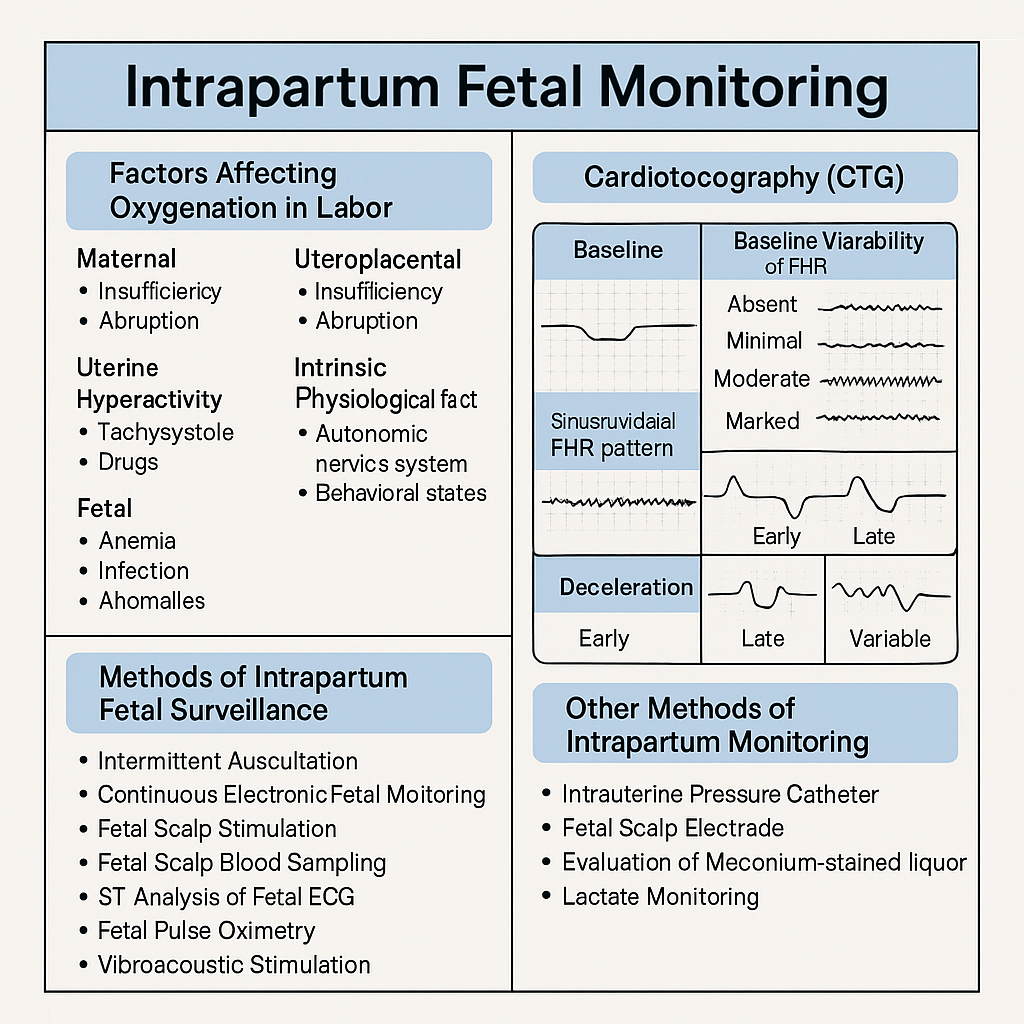
## **1️⃣ Factors Affecting Fetal Oxygenation During Labor**

Fetal oxygenation depends on uninterrupted flow across **four levels**:

### **A. Maternal Factors**

* **Maternal oxygenation:** Hypoxia, severe anemia, pulmonary disease.
* **Uterine perfusion:** Hypotension (epidural, hemorrhage), dehydration, aortocaval compression.
* **Uterine hyperactivity:** Tachysystole (>5 contractions/10 min), hypertonus ↓ intervillous blood flow.
* **Drugs:** β-agonists ↑ fetal tachycardia; opioids ↓ variability.

### **B. Uteroplacental Factors**

* Placental insufficiency (hypertension, preeclampsia, post-maturity).
* Placental abruption, infarction, previa, accreta spectrum.
* Umbilical cord compression (oligohydramnios, cord prolapse, tight nuchal cord).

### **C. Fetal Factors**

* Fetal anemia, infections, acidosis.
* Congenital anomalies (especially CNS, cardiac).
* Prematurity → reduced variability.

### **D. Intrinsic Physiological Factors**

* Autonomic nervous system balance (sympathetic/parasympathetic).
* Fetal behavioral states (quiet sleep cycles ↓ variability).

---

## **2️⃣ Methods of Intrapartum Fetal Surveillance**

### **A. Intermittent Auscultation (IA)**

* Using **Pinard stethoscope** or **Doppler**.
* Low-risk pregnancies.
* Frequency:

* **1st stage:** every 30 min
* **2nd stage:** every 5 min
* Look for: baseline, accelerations, decelerations.

### **B. Continuous Electronic Fetal Monitoring (EFM / CTG)**

* External US transducer + tocodynamometer.
* Internal scaling: scalp electrode + IUPC (intrauterine pressure catheter) when needed.

### **C. Fetal Scalp Stimulation**

* Acceleration after stimulation → reassuring (pH > 7.2).

### **D. Fetal Scalp Blood Sampling (FBS)**

→ Direct measure of fetal acid-base status.

* **Normal pH ≥ 7.25**
* **Borderline 7.21–7.24**
* **Abnormal < 7.20** → urgent delivery.

### **E. ST-Analysis of Fetal ECG (STAN)**

* Detects myocardial hypoxia (ST changes).
* Used with CTG.

### **F. Fetal Pulse Oximetry (rare)**

* Reassurance if SpO₂ > 30%.

### **G. Vibroacoustic Stimulation**

* Sound stimulus → acceleration = good oxygenation.

---

## **3️⃣ Cardiotocography (CTG) – Complete Interpretation**

CTG has **5 components**:
**Baseline, Variability, Accelerations, Decelerations, Contractions.**

---

## **3.1 Baseline Fetal Heart Rate**

Normal: **110–160 bpm**

### **Tachycardia (>160 bpm) causes:**

* Maternal fever (chorioamnionitis)
* Fetal hypoxia early
* Fetal anemia
* Drugs: β-agonists, atropine

### **Bradycardia (<110 bpm) causes:**

* Vagal stimulation (head compression)
* Cord compression
* Prolonged deceleration → late sign of hypoxia

---

## **3.2 Baseline Variability (BV)**

Reflects fetal autonomic integrity.

| **Type** | **Range** | **Significance** |
| --------------------- | ------------ | ------------------------------------------ |
| Absent | 0 bpm | Severe hypoxia, acidosis, drugs |
| Minimal | <5 bpm | Sleep cycle, opioids, prematurity, hypoxia |
| **Moderate (Normal)** | **6–25 bpm** | Good oxygenation |
| Marked | >25 bpm | Early hypoxia, cord compression |

---

## **3.3 Accelerations**

* Abrupt ↑ in FHR by ≥15 bpm for ≥15 sec.
* **Reassuring sign** → fetal well-being.

---

## **3.4 Decelerations — Types & Complete Interpretation**

### **A. Early Decelerations**

* Mirror contractions.
* Due to **head compression**.
* **Benign, no treatment.**

### **B. Late Decelerations**

* Begin after the contraction peak → return after contraction ends.
* Due to **uteroplacental insufficiency**.
* **Always concerning**, esp. with absent variability.

### **C. Variable Decelerations**

* Abrupt fall in FHR, variable shape.
* Due to **cord compression**.
* May have "shoulders" (pre- & post-acceleration).
* Severe if >60 bpm drop lasting >60 sec.

### **D. Prolonged Deceleration**

* FHR drop ≥15 bpm lasting **2–10 min**.
* > 10 min = change in baseline.

### **E. Sinusoidal Pattern (MOST IMPORTANT)**

**True Sinusoidal Pattern**

* Smooth, regular, sine-wave oscillation (3–5 cycles/min)
* Amplitude 5–15 bpm
* No variability, no accelerations
* **Causes:**

* Severe fetal anemia (Rh isoimmunization, fetomaternal hemorrhage)
* Twin-to-twin transfusion
* Hypoxia late stage
* **Immediate delivery required**

**Pseudo-sinusoidal:**

* Seen with opioids — benign.

---

## **4️⃣ NICE 2024 Categories of CTG Interpretation**

| Category | Findings | Action |
| ------------------------------- | -------------------------------------------------------- | ------------------------------------------------ |
| **Normal (Category I)** | Baseline 110–160, Variability 6–25, No repetitive decels | Continue |
| **Suspicious (Category II)** | One non-reassuring feature | Correct reversible causes, close monitoring |
| **Pathological (Category III)** | ≥1 abnormal feature OR ≥2 non-reassuring | Immediate evaluation, FBS, or expedited delivery |

### **Features**

**Reassuring:**

* Baseline 110–160
* Variability 6–25
* No decelerations / early decels
* Accelerations present

**Non-reassuring:**

* Baseline 100–109 or 161–180
* Variability <5 for 40–90 min
* Variable decels with features
* Single prolonged decel <3 min

**Abnormal:**

* Baseline <100 or >180
* Variability <5 for >90 min
* Late decels / prolonged decels >3 min
* Sinusoidal pattern

---

## **5️⃣ Management of Abnormal CTG**

### **A. Correct Reversible Causes**

* Left lateral position
* IV fluids → treat maternal hypotension
* Stop oxytocin (if tachysystole)
* Tocolysis if uterine hyperstimulation (Terbutaline 0.25 mg SC)
* Oxygen (only if maternal hypoxia)

### **B. Fetal Assessment**

* Fetal scalp stimulation
* FBS (pH or lactate)

### **C. Delivery**

* If pH <7.20 OR pathological CTG persists
* Emergency LSCS or instrumental delivery depending on stage

---

## **6️⃣ Other Methods of Intrapartum Monitoring**

### **A. Intrauterine Pressure Catheter (IUPC)**

* Measures **Montevideo units**
* Adequate labor: **>200 MVU**

### **B. Fetal Scalp Electrode (FSE)**

* Accurate beat-to-beat FHR
* Used when external CTG is poor.

### **C. Meconium-stained liquor evaluation**

* Thick meconium + abnormal CTG → intrapartum hypoxia risk.

### **D. Lactate Monitoring**

* Fetal scalp lactate <4.8 mmol/L reassuring.

---

## **7️⃣ Quick High-Yield Revision Table**

| Topic | Key Points |
| ------------------------------- | ------------------------------- |
| Best indicator of fetal hypoxia | **Reduced variability** |
| Worst CTG sign | **Sinusoidal pattern** |
| Earliest sign of hypoxia | **Tachycardia** |
| Most common deceleration | **Variable (cord compression)** |

---

If you want, I can also generate:
✅ SEO title, description & keywords
✅ 25 hard case-based MCQs (HTML + CSS + JS EXAM MODE)
✅ 25 case scenarios with management
✅ Medical diagram image (via image generator)
Just tell me **“continue”** with what you need.

HTML Versions