Home
Pregnancy-Induced Hypertension (PIH): Complete Causes, Symptoms, Diagnosis & Treatment Guide Below is a **complete, concise-but-exhaustive, exam-ready medical reference** on **Pregnancy-Induced Hypertension (PIH)**—also called **gestational hypertension**.
Covers: **definition, pathophysiology, etiologies, risk factors, clinical features, investigations, differential diagnosis, complications (maternal & fetal), management (stepwise), drugs with dosing + MOA + AEs + contraindications + monitoring**, delivery timing, prevention, counseling.
---
# ⭐ **PREGNANCY-INDUCED HYPERTENSION (PIH) — COMPLETE DETAILS**


---
# **1️⃣ Definition**
**PIH = Gestational Hypertension**
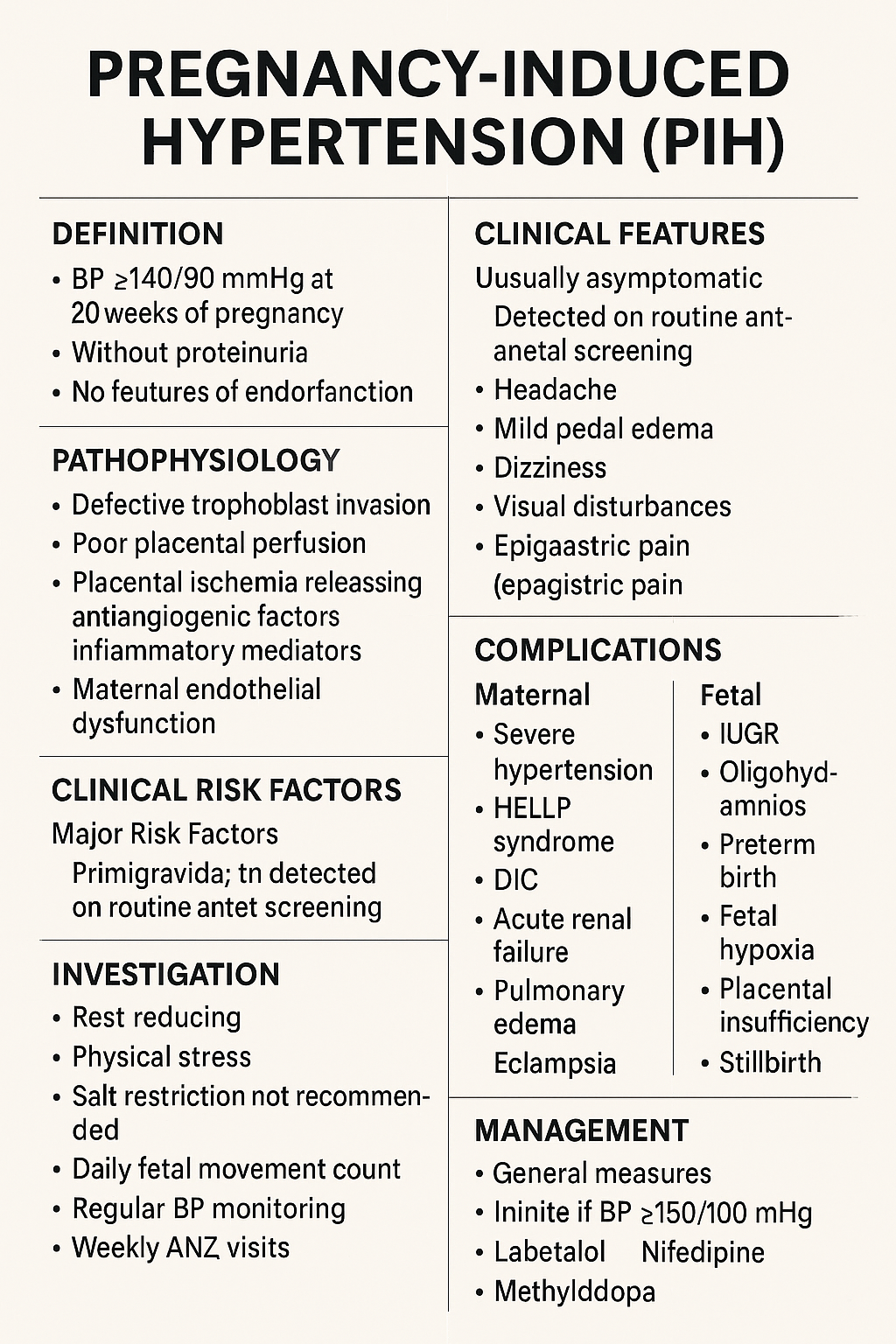
* **BP ≥140/90 mmHg** after **20 weeks** of pregnancy
* **No proteinuria**
* **No features of end-organ dysfunction**
* BP becomes normal within **12 weeks postpartum**
---
# **2️⃣ Epidemiology**
* Occurs in **6–10%** of pregnancies
* More common in **primigravida**, **multiple gestation**, **teenage pregnancy**, **advanced maternal age**
---
# **3️⃣ Etiology & Risk Factors**
### **Major Risk Factors**
* Primigravida
* Family history of PIH/Preeclampsia
* Personal history of PIH
* Multiple pregnancy
* Molar pregnancy
* Diabetes, Obesity, Chronic hypertension
* Autoimmune disease
* Renal disease
* Thrombophilias
* Advanced maternal age (>35 years)
---
# **4️⃣ Pathophysiology (Simplified & Complete)**


### **Normal Pregnancy**
* Trophoblast invades → spiral arteries remodel → become wide, low-resistance → good placental perfusion.
### **PIH / Preeclampsia Spectrum**
1. **Defective trophoblastic invasion** → incomplete spiral artery remodeling
2. **Placental ischemia** → oxidative stress
3. **Release of antiangiogenic factors** (sFlt-1, endoglin) and inflammatory mediators
4. **Maternal endothelial dysfunction** →
* ↑ vascular resistance
* ↑ capillary permeability
* Hypercoagulability
🔹 **PIH = mild endotheliopathy without proteinuria or organ dysfunction**
🔹 **Preeclampsia = PIH + proteinuria or organ dysfunction**
---
# **5️⃣ Diagnostic Criteria**
### **BP Measurement**
* Two readings ≥140/90 mmHg
* At least 4 hours apart
* After 20 weeks gestation
* No proteinuria
* No systemic symptoms
### **Proteinuria must be absent**
* Dipstick <1+
* Spot urine protein/creatinine ratio <0.3
* 24-hr urinary protein <300 mg
---
# **6️⃣ Clinical Features**
### **Usually Asymptomatic**
Detected on routine antenatal screening.
### **If symptoms appear**
* Headache
* Mild pedal edema
* Dizziness
* Visual disturbances (suggest severe disease progression)
* Epigastric pain (danger sign)
---
# **7️⃣ Investigations (Complete Panel)**
### **Basic**
* BP monitoring
* Urinalysis (protein)
* CBC
* LFTs (AST/ALT)
* Renal function test (creatinine, uric acid)
### **For progression to Preeclampsia**
* Urine PCR
* Peripheral smear (hemolysis)
* Coagulation profile
* LDH
* Fundus examination
### **Fetal Evaluation**
* Ultrasound for growth
* AFI
* Doppler velocimetry
* NST / BPP
---
# **8️⃣ Differential Diagnosis**
* **Chronic hypertension**
* **White coat hypertension**
* **Preeclampsia**
* **Transient hypertension of pregnancy**
* **Renal disease**
* **Thyroid disorders**
* **Drug-induced hypertension**
---
# **9️⃣ Maternal Complications**
### **If PIH progresses → Preeclampsia/Eclampsia**
* Severe hypertension
* HELLP syndrome
* DIC
* Acute renal failure
* Pulmonary edema
* Placental abruption
* Eclampsia
* Stroke / Intracranial hemorrhage
---
# **🔟 Fetal Complications**
* IUGR
* Oligohydramnios
* Preterm birth
* Fetal hypoxia
* Placental insufficiency
* Stillbirth
---
# **1️⃣1️⃣ Management (Complete Stepwise Protocol)**


---
## **A. General Measures**
* Rest, preferably left lateral
* Reduce physical stress
* Salt restriction **NOT** recommended severely, only normal diet
* Daily fetal movement count
* Regular BP monitoring
* Weekly ANC visits
---
## **B. Threshold for Treatment**
* **Treat if BP ≥150/100 mmHg**
* For **140–149/90–99 → Monitor only**, no medication unless comorbidity
---
## **C. First-Line Antihypertensive Drugs in Pregnancy**
---
# **🔹1. Labetalol (Drug of Choice)**
**MOA:** α-1 & β-blocker → ↓ SVR & BP
**Dose:**
* Oral: 100–200 mg twice daily → up to 2,400 mg/day
* IV (for severe): 20 mg bolus → 40 mg → 80 mg q10min (max 300 mg)
**PK:** Hepatic metabolism
**Common AEs:** Fatigue, dizziness
**Serious AEs:** Bradycardia, hypotension
**Contraindications:** Asthma, heart block
**Monitoring:** BP, HR
**Counselling:** Avoid abrupt stopping
---
# **🔹2. Nifedipine (Long-acting)**
**MOA:** Calcium channel blocker → vasodilation
**Dose:** 30–60 mg sustained-release OD
**PK:** Hepatic
**Common AEs:** Headache, flushing
**Serious AEs:** Hypotension
**Contraindications:** Aortic stenosis
**Interactions:** Magnesium sulfate ↑ hypotension risk
**Monitoring:** BP
**Counselling:** Do not chew CR tablets
---
# **🔹3. Methyldopa (Safe in pregnancy)**
**MOA:** Central α2 agonist
**Dose:** 250–500 mg 2–3 times/day
**PK:** Renal
**Common AEs:** Sedation, depression, dry mouth
**Serious AEs:** Liver dysfunction, hemolytic anemia
**Monitoring:** LFTs
**Counselling:** May cause drowsiness
---
# ❌ **Drugs Contraindicated**
* ACE inhibitors
* ARBs
* Atenolol
* Diuretics (except pulmonary edema)
---
# **1️⃣2️⃣ Management of Severe PIH**
* BP ≥160/110 mmHg
* Admit
* IV labetalol / oral nifedipine
* Evaluate for preeclampsia
* Magnesium sulfate if criteria for severe features
---
# **1️⃣3️⃣ Magnesium Sulfate (for progression to severe/eclampsia)**
**MOA:** CNS depressant → prevents seizures by NMDA blockade
**Dose (Pritchard):**
* 4 g IV loading + 10 g IM (5 g each buttock)
* 5 g IM q4h
**Monitoring:**
* Respiratory rate
* Urine output (>30 ml/hr)
* Patellar reflex
**Toxicity:** Respiratory depression → treat with **10% calcium gluconate 10 ml IV**
---
# **1️⃣4️⃣ Delivery Timing**
| Condition | Timing |
| ------------------------------------------------ | ------------------------- |
| **PIH (controlled)** | **37 weeks** |
| **Severe PIH** | 34 weeks (after steroids) |
| **Uncontrolled BP, fetal compromise, abruption** | Immediate delivery |
---
# **1️⃣5️⃣ Intrapartum Care**
* Continuous fetal monitoring
* Keep BP <160/110
* Avoid fluid overload
* Anesthesia: regional preferred unless contraindicated
---
# **1️⃣6️⃣ Postpartum Care**
* Continue antihypertensives
* Monitor BP for **12 weeks**
* If persistent → chronic hypertension
---
# **1️⃣7️⃣ Prevention of PIH**
* Low-dose **Aspirin 75–150 mg at bedtime** from **12–16 weeks** in high-risk women
* Calcium supplementation (1–1.5 g/day) in low-calcium diets
* Weight control
* Control comorbidities
---
# **1️⃣8️⃣ Patient Counseling Points**
* Regular BP monitoring
* Danger signs: headache, visual symptoms, epigastric pain
* Adherence to medications
* Fetal kick count
* Importance of follow-up
* No self-discontinuation of drugs
---
# ⭐ If you want, I can also provide:
✅ **Flowchart of PIH diagnosis**
✅ **Flowchart of management**
✅ **HTML/CSS/JS quiz (hard, case-based)**
✅ **SEO title + description + keywords**
✅ **Image generation**
Just tell me what you need next! HTML Versions