Teratogenic Exposure in Pregnancy: 25 High-Yield Case Scenarios, Diagnosis & Management | Complete 2025 Obstetrics Guide

Teratogenic Exposure in Pregnancy: 25 High-Yield Case Scenarios, Diagnosis & Management | Complete 2025 Obstetrics Guide
Below is a **compact but fully comprehensive, exam-ready medical note** on **Teratogenic Exposure in Pregnancy**, covering radiation, drugs, infections, maternal diseases, hyperthermia, SLE, PKU, mechanisms, critical periods, dose effects, and hallmark malformations.

---

# ⭐ **TERATOGENIC EXPOSURE IN PREGNANCY — COMPLETE MASTER NOTE (NEET PG / INICET LEVEL)**

---

# **1. Key Definitions**

* **Teratogen** = Any agent that causes **structural or functional defects** in the developing embryo/fetus.
* **Critical Period** = **3–8 weeks (organogenesis)** → highest sensitivity.
* **Types of effects:**
✔ Structural malformations (first trimester)
✔ Growth restriction
✔ Functional deficits (CNS, endocrine)
✔ Fetal death or abortion

---

# **2. Critical Period by Gestation**

| Period | Effect |
| -------------------------------- | -------------------------------------------- |
| **Pre-implantation (0–2 weeks)** | “All or none” effect – loss or normal embryo |
| **Organogenesis (3–8 weeks)** | **Major structural defects** |
| **Fetal period (9 weeks–term)** | **Growth, CNS, functional defects** |

---

# **3. Teratogenic Radiation Exposure**

## **Mechanism**

* DNA breaks → apoptosis, impaired cell migration → structural defects.

## **Threshold Dose**

* **<50 mGy** → *no fetal harm (safe).*
* **50–100 mGy** → minimal risk.
* **>100–200 mGy** → risk of malformations ↑.
* **>500 mGy** → severe malformations & pregnancy loss.

## **Gestational-Age–Specific Effects**

| Age | Effects |
| -------------- | -------------------------------------------------------------------------------- |
| **0–2 weeks** | Pregnancy loss (all-or-none). |
| **3–8 weeks** | Congenital malformations – **microcephaly**, microphthalmia, skeletal anomalies. |
| **8–15 weeks** | **Severe intellectual disability**, growth restriction. |
| **>16 weeks** | Mild intellectual disability, IUGR. |

## **Imaging Safety**

* **Chest X-ray, CT brain, limb X-ray, dental X-ray** → fetal exposure **<1–2 mGy** → **SAFE**.
* **CT abdomen/pelvis** → 10–25 mGy → still below teratogenic threshold but avoid unless needed.

---

# **4. Major Teratogenic Drugs & Their Classical Malformations**

## **A. Antiepileptics**

### **Valproate**

* **Neural tube defects (NTD)** – spina bifida
* Craniofacial anomalies
* Cardiac defects
* Cognitive impairment

### **Carbamazepine**

* NTD
* Craniofacial defects
* Fingernail hypoplasia

### **Phenytoin**

* **Fetal Hydantoin Syndrome**
– Growth deficiency
– Microcephaly
– Distal phalangeal hypoplasia
– Cleft palate

### **Topiramate**

* Oral clefts
* Low birth weight

---

## **B. Retinoids**

### **Isotretinoin**

**One of the strongest teratogens**
Malformations:

* Craniofacial (microtia, anotia)
* Conotruncal heart defects
* CNS anomalies
* Thymic aplasia

---

## **C. Anticoagulants**

### **Warfarin**

* **Fetal warfarin syndrome**:
– Nasal hypoplasia
– Stippled epiphyses
– Limb hypoplasia
– CNS defects
– Developmental delay
* Highest risk **6–12 weeks**.

*Heparin is SAFE.*

---

## **D. Antithyroid Drugs**

### **Methimazole**

* **Aplasia cutis**
* Choanal/esophageal atresia

### **Propylthiouracil (PTU)**

* Liver toxicity more than teratogenicity → preferred in **first trimester**.

---

## **E. ACE inhibitors / ARBs**

* **Renal tubular dysgenesis**
* **Oligohydramnios sequence**
* Pulmonary hypoplasia
* Limb contractures
* Skull ossification defects

---

## **F. NSAIDs**

* **Ductus arteriosus closure** (third trimester)
* Pulmonary hypertension
* Oligohydramnios (↓ fetal renal perfusion)

---

## **G. Chemotherapy**

* Cyclophosphamide → limb defects, cleft palate
* Methotrexate → NTD, craniofacial anomalies, growth restriction
* Busulfan → hyperpigmentation, growth restriction

---

## **H. Others**

* Lithium → **Ebstein anomaly**
* Thalidomide → **Phocomelia** (seal-like limbs)
* Misoprostol → Moebius sequence (cranial nerve palsies)
* Alcohol → **Fetal alcohol syndrome** (smooth philtrum, thin upper lip, microcephaly, growth restriction)
* Cocaine → placental abruption, IUGR, limb defects
* SSRIs (Paroxetine) → cardiac malformations

---

# **5. Teratogenic Infections (TORCH & Others)**

## **T – Toxoplasmosis**

* Classic triad:
✔ Hydrocephalus
✔ Intracranial calcifications (diffuse)
✔ Chorioretinitis

---

## **O – Other**

### **Syphilis**

* Hutchinson teeth
* Saddle nose
* Deafness
* Hepatosplenomegaly
* Snuffles

### **Varicella**

* Limb hypoplasia
* Cicatricial skin lesions
* Microcephaly
* Ocular defects

### **Zika**

* Severe microcephaly
* Intracranial calcifications
* Arthrogryposis

---

## **R – Rubella**

* **Classic triad:**
✔ PDA or pulmonary artery stenosis
✔ Cataracts
✔ Sensorineural deafness

---

## **C – CMV**

* Periventricular calcifications
* Microcephaly
* Seizures
* Sensorineural hearing loss
* IUGR

---

## **H – Herpes Simplex**

* Skin vesicles
* Chorioretinitis
* Microcephaly
* Encephalitis

---

# **6. Maternal Hyperthermia (>38.9°C)**

Mechanism: Protein denaturation, impaired cell migration during neurulation.

**Malformations:**

* Neural tube defects
* Congenital heart disease
* Facial clefts
* Miscarriage risk ↑
Common causes: Fever, sauna use, hot tub exposure (prolonged).

---

# **7. Maternal Diseases as Teratogens**

## **A. Maternal Phenylketonuria (PKU)**

If poorly controlled maternal phenylalanine:

**Fetal effects:**

* Microcephaly
* Intellectual disability
* Congenital heart disease (TOF, VSD)
* IUGR

*Key: Teratogenicity comes from maternal high phenylalanine, NOT fetal PKU.*

---

## **B. Diabetes Mellitus**

* Caudal regression syndrome
* Macrosomia (if uncontrolled later)
* NTD
* Congenital heart disease
* Renal anomalies
* Sacral agenesis is CLASSIC.

---

## **C. Systemic Lupus Erythematosus (SLE) in Pregnancy**

Two types of fetal effects:

### **1. Due to Anti-Ro/SSA and Anti-La/SSB antibodies**

* **Congenital heart block** (third-degree)
* Neonatal lupus rash
* Cytopenias
* Hepatitis

### **2. Due to maternal disease activity**

* IUGR
* Preterm birth
* Preeclampsia
* Placental insufficiency

**Safe drugs in pregnancy:**

* Hydroxychloroquine
* Low-dose aspirin
* Prednisolone
* Azathioprine

---

# **8. Summary Table (Exam-Level High Yield)**

| Teratogen | Classic Malformation |
| -------------- | ------------------------------------------ |
| Valproate | Neural tube defects |
| Warfarin | Nasal hypoplasia, stippled epiphyses |
| Isotretinoin | Ear defects, heart defects, thymic aplasia |
| Lithium | Ebstein anomaly |
| Thalidomide | Phocomelia |
| Alcohol | Smooth philtrum, microcephaly |
| Misoprostol | Moebius sequence |
| Methimazole | Aplasia cutis |
| ACE inhibitors | Renal dysgenesis, oligohydramnios |
| CMV | Periventricular calcifications |
| Toxoplasmosis | Diffuse intracranial calcifications |
| Rubella | PDA + cataracts + deafness |
| PKU | CHD + microcephaly |
| Hyperthermia | NTD |
| SLE antibodies | Congenital heart block |

---

# **9. Clinical MCQ Triggers**

* **Warfarin exposure at 8 weeks → nasal hypoplasia**
* **Valproate use during 1st trimester → NTD**
* **Maternal fever during 4 weeks → anencephaly risk**
* **Anti-Ro positive mother → fetal bradycardia → complete heart block**
* **Isotretinoin → ear + thymic anomalies**
* **CMV → periventricular calcifications**
* **Toxoplasma → hydrocephalus + diffuse calcifications**

---

If you want, I can also generate:

✅ **Hard NEET PG/INICET MCQs (20 or 50)**
✅ **HTML exam-mode MCQ file**
✅ **Concise PDF note**
✅ **Infographic image**

Just tell me what format you want next.
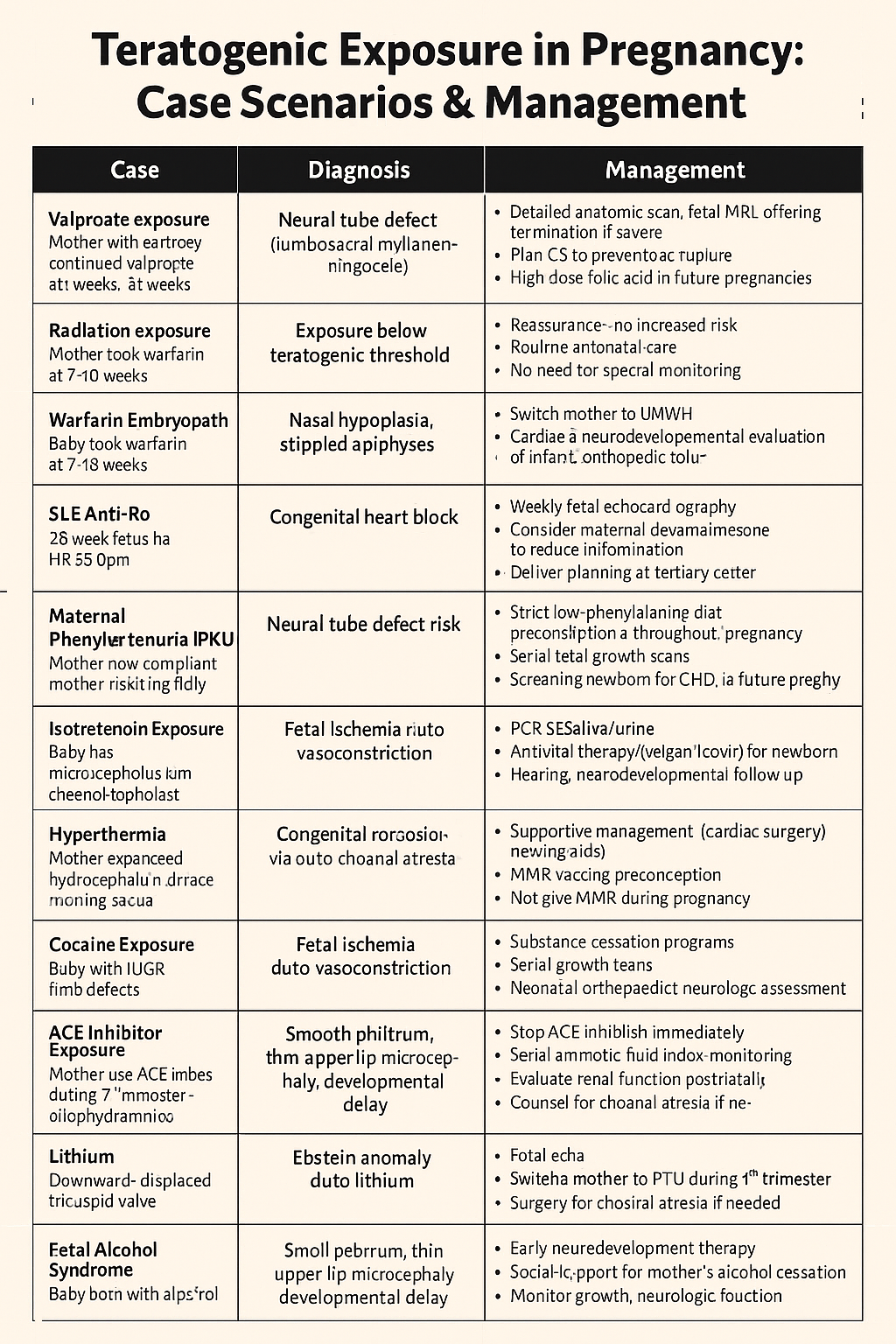
Here are **25 high-yield, exam-level case scenarios with detailed diagnosis + management**, fully aligned with **NEET PG / INICET clinical reasoning**.

These cover:
✔ Teratogenic drugs
✔ Radiation exposure
✔ Infections (TORCH)
✔ PKU
✔ SLE
✔ Hyperthermia
✔ Diabetes
✔ Cocaine / Alcohol exposure
✔ Antithyroid drugs
✔ Antiepileptics
✔ ACE inhibitors
✔ Lithium
✔ Retinoids
✔ Chemotherapy

---

# ⭐ **25 DETAILED CASE SCENARIOS WITH MANAGEMENT**

---

# **1. Valproate Exposure → Neural Tube Defect**

**Case:**
A 24-year-old pregnant woman with epilepsy continued valproate during early pregnancy. At 18 weeks, USG reveals **lumbosacral myelomeningocele**.

**Diagnosis:** Teratogenic valproate exposure causing NTD.

**Management:**

* Detailed anatomic scan + fetal MRI
* Offer termination if severe
* If continuing pregnancy → plan for CS to prevent sac rupture
* High-dose folic acid in future pregnancies (4 mg/day)

---

# **2. Radiation Exposure (<50 mGy)**

**Case:**
A 28-year-old woman had CT KUB (18 mGy) before realizing she was 4 weeks pregnant.

**Diagnosis:** Exposure *below teratogenic threshold*.

**Management:**

* Reassure — no increased risk
* Routine antenatal care
* No need for special monitoring

---

# **3. Warfarin Embryopathy**

**Case:**
Baby born with **nasal hypoplasia, stippled epiphyses**, short limbs. Mother took warfarin at 7–10 weeks.

**Diagnosis:** Warfarin embryopathy.

**Management:**

* Switch mother to LMWH
* Cardiac + neurodevelopmental evaluation of infant
* Orthopedic follow-up

---

# **4. SLE Anti-Ro → Congenital Heart Block**

**Case:**
Mother with SLE (anti-Ro +). At 28 weeks, fetus has HR 55 bpm.

**Diagnosis:** Fetal complete heart block.

**Management:**

* Weekly fetal echocardiography
* Consider maternal dexamethasone to reduce inflammation
* Delivery planning at tertiary center
* Pacemaker may be needed postnatally

---

# **5. Maternal Phenylketonuria (PKU)**

**Case:**
Mother not compliant with low-phenylalanine diet → baby has **microcephaly + congenital heart disease**.

**Diagnosis:** Maternal PKU embryopathy.

**Management:**

* Strict low-phenylalanine diet preconception + throughout pregnancy
* Serial fetal growth scans
* Screen newborn for CHD, developmental delay

---

# **6. Isotretinoin Exposure**

**Case:**
Mother used isotretinoin for acne → baby with **microtia, conotruncal defects, thymic hypoplasia**.

**Diagnosis:** Retinoic acid embryopathy.

**Management:**

* Detailed cardiac imaging
* ENT evaluation
* Immune system assessment
* Counseling: avoid pregnancy for 1 month after stopping isotretinoin

---

# **7. Hyperthermia → Neural Tube Defect Risk**

**Case:**
Mother had continuous fever (39.5°C) at 4 weeks and used sauna.

**Diagnosis:** Risk of NTD due to hyperthermia.

**Management:**

* High-dose folic acid
* Level-II anomaly scan at 18–20 weeks
* Counsel to avoid saunas/hot tubs

---

# **8. CMV Infection**

**Case:**
Baby has **periventricular calcifications, microcephaly, deafness**.

**Diagnosis:** Congenital CMV.

**Management:**

* PCR of saliva/urine
* Antiviral therapy (valganciclovir) for newborn
* Hearing, neurodevelopmental follow-up

---

# **9. Toxoplasmosis**

**Case:**
Ultrasound: **hydrocephalus + diffuse intracranial calcifications**. Mother keeps cats.

**Diagnosis:** Congenital toxoplasmosis.

**Management:**

* Maternal spiramycin (prevents transmission)
* If fetal infection confirmed → pyrimethamine + sulfadiazine + folinic acid
* Fetal MRI
* Neonatal ophthalmologic and neurologic evaluation

---

# **10. Rubella Infection**

**Case:**
Baby born with **cataracts, PDA, deafness**.

**Diagnosis:** Congenital rubella syndrome.

**Management:**

* Supportive management (cardiac surgery, hearing aids)
* Preventive: MMR vaccine preconception
* Do NOT give MMR during pregnancy

---

# **11. Cocaine Exposure**

**Case:**
Baby with **IUGR, limb defects**, placental thrombi. Mother admits cocaine use.

**Diagnosis:** Fetal ischemia due to vasoconstriction.

**Management:**

* Substance cessation programs
* Serial growth scans
* Neonatal orthopedic + neurology assessment

---

# **12. ACE Inhibitor Exposure**

**Case:**
Mother used ACE inhibitors during 2nd trimester → fetus shows oligohydramnios and hypoplastic lungs.

**Diagnosis:** Renal tubular dysgenesis from ACE inhibitor fetopathy.

**Management:**

* Stop ACE inhibitor immediately
* Serial amniotic fluid index monitoring
* Evaluate renal function postnatally
* Risk of neonatal renal failure

---

# **13. Lithium → Ebstein Anomaly**

**Case:**
Mother took lithium → baby has **downward displaced tricuspid valve**.

**Diagnosis:** Ebstein anomaly due to lithium.

**Management:**

* Fetal echo
* After birth: manage heart failure, arrhythmias
* Consider switching to safer bipolar drug in future pregnancy (e.g., lamotrigine)

---

# **14. Methimazole Embryopathy**

**Case:**
Baby born with **aplasia cutis + choanal atresia**.

**Diagnosis:** Methimazole teratogenicity.

**Management:**

* ENT evaluation
* Switch mother to PTU during 1st trimester
* Surgery for choanal atresia if needed

---

# **15. Fetal Alcohol Syndrome**

**Case:**
Baby has **smooth philtrum, thin upper lip, microcephaly, developmental delay**.

**Diagnosis:** Fetal Alcohol Syndrome.

**Management:**

* Early neurodevelopment therapy
* Social support for mother’s alcohol cessation
* Monitor growth, neurologic function

---

# **16. Methotrexate Exposure**

**Case:**
Mother took methotrexate early in pregnancy → baby has **growth restriction, craniofacial anomalies**, limb defects.

**Diagnosis:** Methotrexate embryopathy.

**Management:**

* Stop methotrexate → give folinic acid rescue
* Detailed fetal anomaly scan
* Counseling about recurrence risk

---

# **17. Phenytoin Exposure (Fetal Hydantoin Syndrome)**

**Case:**
Baby has **growth deficiency, nail hypoplasia, cleft palate**.

**Diagnosis:** Fetal hydantoin syndrome.

**Management:**

* Optimize maternal AED therapy (prefer levetiracetam/lamotrigine)
* High-dose folic acid
* Neonatal audiology + cardiology evaluation

---

# **18. Carbamazepine Exposure**

**Case:**
Baby has NTD + craniofacial anomalies.

**Diagnosis:** Carbamazepine teratogenicity.

**Management:**

* Anomaly scan
* Folic acid supplementation
* Switch to safer AED if possible

---

# **19. NSAID Exposure in 3rd Trimester**

**Case:**
Mother using ibuprofen daily → fetus has **premature ductus arteriosus closure**.

**Diagnosis:** NSAID fetopathy.

**Management:**

* Stop NSAID immediately
* Fetal echo
* Treat pulmonary hypertension postnatally if needed

---

# **20. Misoprostol → Moebius Sequence**

**Case:**
Baby has **facial nerve palsy, limb defects**. Mother used misoprostol early.

**Diagnosis:** Moebius sequence due to vascular disruption.

**Management:**

* MRI brain
* Neurology evaluation
* Supportive care for feeding, facial function

---

# **21. Varicella Embryopathy**

**Case:**
Baby has **limb hypoplasia, cicatricial skin scars, microcephaly**.

**Diagnosis:** Congenital varicella syndrome.

**Management:**

* Maternal: give VZIG if exposure occurs
* Newborn: acyclovir therapy
* Ophthalmology + neurology follow-up

---

# **22. Diabetes Embryopathy**

**Case:**
Mother with uncontrolled diabetes → baby with **caudal regression syndrome**.

**Diagnosis:** Diabetic embryopathy.

**Management:**

* Preconception strict glycemic control
* Fetal anomaly scan
* Screening for CHD, renal anomalies

---

# **23. Chemotherapy Exposure (Cyclophosphamide)**

**Case:**
Mother treated for lymphoma in 1st trimester → baby born with **cleft palate, limb defects**.

**Diagnosis:** Chemotherapy teratogenesis.

**Management:**

* Ideally avoid chemotherapy in 1st trimester
* After birth: surgical corrections + follow-up

---

# **24. HSV Infection**

**Case:**
Baby born with **vesicular lesions, chorioretinitis, encephalitis**.

**Diagnosis:** Congenital/neonatal HSV.

**Management:**

* IV acyclovir
* CS delivery if active maternal lesions
* Ophthalmology + neurology assessment

---

# **25. Miscarriage after High Radiation (>500 mGy)**

**Case:**
Woman exposed to 700 mGy radiation at 3 weeks → early pregnancy loss.

**Diagnosis:** Radiation-induced embryonic lethality.

**Management:**

* Counseling about dose–response effects
* Explain “all-or-none” phenomenon at pre-implantation stage
* Optimize radiation safety protocols

---

# ✅ WANT THESE IN HTML EXAM MODE?

I can convert all **25 case scenarios** into:

✔ interactive exam-mode HTML
✔ collapsible answers
✔ JSON file for your website
✔ Printable PDF
✔ Add 25 or 50 more cases

Just tell me **which format you want next.**
Here is your **complete, high-yield, concise-but-exhaustive medical note on CMV (Cytomegalovirus)** — written in your preferred **NEET PG / INICET master-note pattern**.

---

# ⭐ **CYTOMEGALOVIRUS (CMV) – COMPLETE CLINICAL NOTE (OB/GYN + MEDICINE)**

*Congenital infection • TORCH • Immunocompromised disease • Pregnancy effects*

---

# **1. Definition**

CMV is a **beta-herpesvirus** causing latent lifelong infection.
It is the **most common congenital viral infection worldwide**.

Transmission:

* **Vertical (transplacental)** – primary maternal infection highest risk
* **Peripartum** – genital secretions
* **Postnatal** – breast milk
* **Other** – saliva, urine, blood transfusion, organ transplant

---

# **2. Pathophysiology**

* CMV infects **endothelial cells, epithelial cells, leukocytes**.
* Causes **cytopathic enlargement ("owl-eye" inclusion bodies)**.
* In fetus → **tissue necrosis**, calcification, neuronal migration defects, hearing damage.
* Maternal primary infection → **40% transmission risk**
* Recurrent infection → **1–2% transmission**, usually mild.

---

# **3. Causes / Risk Factors**

* Primary maternal CMV infection during pregnancy
* Day-care exposure (toddlers shed CMV in urine/saliva)
* Immunocompromised states: HIV, transplant, chemotherapy
* Blood products without leukoreduction

---

# **4. Clinical Features**

## **A. Maternal CMV**

Usually **asymptomatic**.
If symptomatic → mononucleosis-like: fever, fatigue, lymphadenopathy.

## **B. Congenital CMV – Symptomatic (10%)**

1. **Neurologic**

* Periventricular calcifications
* Microcephaly
* Seizures
* Developmental delay
2. **Sensory**

* **Sensorineural hearing loss (MC long-term sequela)**
* Chorioretinitis
3. **Systemic**

* Jaundice
* Hepatosplenomegaly
* Thrombocytopenia → “blueberry muffin rash”
* IUGR
4. **Other**

* Ventriculomegaly
* Liver dysfunction

## **C. Congenital CMV – Asymptomatic (90%)**

* Normal at birth
* **10–15% develop hearing loss later**

---

# **5. Investigations / Diagnosis**

### **Maternal testing**

* **CMV IgG + IgM**
* **IgG avidity**

* Low → recent infection
* High → past infection
* **PCR for CMV DNA** in blood/urine (if needed)

### **Fetal testing**

* **Ultrasound findings**:

* Ventriculomegaly
* Periventricular calcifications
* Echogenic bowel
* IUGR
* Hepatosplenomegaly
* Ascites
* **Amniocentesis (after 21 weeks; ≥6 weeks after maternal infection)**

* CMV DNA PCR **gold standard** for fetal diagnosis.

### **Neonatal testing**

* **Urine/saliva CMV PCR within 21 days of birth**
* CBC, LFTs, Cranial USG, hearing evaluation.

---

# **6. Differential Diagnosis**

* Other **TORCH** infections (Toxo, Rubella, HSV, Syphilis)
* Zika virus
* Genetic microcephaly syndromes
* Neonatal hepatitis
* Peroxisomal disorders

---

# **7. Management**

## **A. Maternal**

* **No routine antiviral treatment in pregnancy**.
* **Valganciclovir / Ganciclovir NOT recommended routinely** (teratogenic + limited benefit).
* Prevention: avoid saliva/urine contact from toddlers, hand hygiene.

## **B. Fetal**

* Consider **CMV hyperimmune globulin** (evidence mixed; may decrease severity).
* Serial fetal USG every 2–4 weeks for growth & brain changes.

## **C. Neonatal**

**Indication for antiviral therapy (Valganciclovir):**

* Moderate/severe symptomatic congenital CMV
* Isolated sensorineural hearing loss (recent evidence supports)

### **Drug details: Valganciclovir**

* **Mechanism**: Inhibits CMV DNA polymerase
* **Dose**:

* Neonatal: 16 mg/kg PO twice daily for **6 months**
* **Adverse effects**: Neutropenia, anemia, hepatotoxicity
* **Monitoring**: CBC weekly initially, then monthly; LFTs
* **Counselling**: Importance of adherence, follow-up hearing tests.

---

# **8. Complications**

* **Sensorineural hearing loss** (most common)
* Blindness
* Microcephaly & intellectual disability
* Epilepsy
* Cerebral palsy
* Feeding problems
* Chronic liver disease

---

# **9. Prevention**

* No vaccine available.
* Pregnant women → avoid sharing utensils, food, kissing toddlers on mouth, frequent handwashing.
* Universal screening **not** recommended currently.
* Blood products: **leukoreduced, CMV-negative** for neonates/immunocompromised.

---

# **10. High-Yield Exam Points**

* **MC congenital infection worldwide → CMV**
* **Periventricular calcifications = CMV**
* Rubella → **subepicardial calcifications**
* Primary maternal infection = **highest fetal risk**
* **Hearing loss = most common sequela**
* Amniocentesis after **21 weeks**, ≥6 weeks after infection for accurate PCR
* Valganciclovir → **only for symptomatic neonates**

---

If you want, I can also provide:
✅ **20 MCQs (NEET PG + INICET level)**
✅ **HTML + CSS + JS exam-mode interface**
✅ **SEO title, description, keywords**
Just tell me **“cmBelow is your **complete, concise but exhaustive medical reference note on *Toxoplasma gondii* infection*** — structured exactly in the pattern you prefer (definition → pathophysiology → causes → clinical features → investigations → differential diagnoses → management → full drug details → pregnancy considerations → prevention).

---

# **TOXOPLASMOSIS — COMPLETE MEDICAL NOTE (NEET PG + INICET + CLINICAL)**

---

## **1. Definition**

Toxoplasmosis is an infection caused by **Toxoplasma gondii**, an obligate intracellular protozoan parasite.
Transmission occurs by **ingestion of oocysts**, **tissue cysts in meat**, **transplacental spread**, **blood transfusion**, or **organ transplant**.

---

## **2. Pathophysiology**

* Parasite exists in 3 forms:

* **Oocysts** (shed from cat feces; infectious after 1–5 days).
* **Tachyzoites** (rapidly dividing; cause acute infection; cross placenta).
* **Bradyzoites** (slow, encysted; cause chronic latent infection in brain, muscle).
* Primary infection in pregnancy → *parasitemia* → **placental invasion → fetal infection**.
* Immunocompromised individuals cannot contain tachyzoites → **necrotizing encephalitis**, pneumonitis, chorioretinitis.

---

## **3. Causes & Risk Factors**

### **Sources of infection**

* Cat feces (oocysts)
* Undercooked pork/lamb (tissue cysts)
* Unwashed vegetables
* Contaminated water
* Transplacental infection (primary maternal infection)

### **High-risk groups**

* Pregnancy
* HIV/AIDS (CD4 <100)
* Transplant recipients
* Patients on high-dose steroids / immunosuppressants

---

## **4. Clinical Features**

### **A. Immunocompetent**

* Mostly **asymptomatic**
* Mild flu-like illness: fever, malaise, sore throat
* **Cervical lymphadenopathy** (most common)
* Retinochoroiditis (can occur later)

---

### **B. Immunocompromised**

* **Toxoplasma encephalitis**:

* Headache
* Fever
* Focal neurological deficits
* Seizures
* Altered mental status
* MRI: **multiple ring-enhancing lesions** in basal ganglia / corticomedullary junction
* Pneumonitis, myocarditis (less common)

---

### **C. Congenital Toxoplasmosis**

Severity depends on gestational age:

* **Early pregnancy infection → severe fetal damage but low transmission**
* **Late pregnancy infection → high transmission but milder disease**

**Classic triad:**

1. **Chorioretinitis**
2. **Hydrocephalus**
3. **Intracranial calcifications** (diffuse, scattered — unlike CMV which is periventricular)

Other features:

* Microcephaly
* Seizures
* Hepatosplenomegaly
* Anemia, thrombocytopenia
* IUGR
* Developmental delay

---

## **5. Investigations**

### **Maternal**

* **Toxoplasma IgM** (acute)
* **IgG** (past infection)
* **IgG avidity test**

* Low avidity → recent infection
* High avidity → infection >3–5 months ago

### **Fetal**

* **Amniotic fluid PCR** for *T. gondii* DNA (best)
* Ultrasound:

* Ventriculomegaly
* Intracranial calcification
* Hepatosplenomegaly
* Ascites

### **Immunocompromised**

* MRI brain: ring-enhancing lesions
* CSF PCR

---

## **6. Differential Diagnosis**

* CMV congenital infection
* Zika infection
* HSV encephalitis
* CNS lymphoma (HIV)
* Tuberculoma
* Neurocysticercosis
* Bartonella lymphadenitis

---

## **7. Management**

---

### **A. Immunocompetent**

Most require **no treatment** unless severe or ocular disease.

---

### **B. Immunocompromised / CNS Toxoplasmosis**

**First-line therapy (6 weeks):**
**Pyrimethamine + Sulfadiazine + Leucovorin**

Then **chronic maintenance** until CD4 >200 for 6 months on ART.

**Alternatives:**

* Pyrimethamine + Clindamycin
* TMP-SMX (for prophylaxis or mild cases)

---

### **C. Pregnancy**

Management depends on fetal infection status:

#### **If maternal infection but fetal infection NOT confirmed**

→ **Spiramycin** (reduces placental transmission)

#### **If fetal infection is confirmed (PCR positive)**

→ **Pyrimethamine + Sulfadiazine + Leucovorin** (avoid in 1st trimester)

---

### **D. Congenital Toxoplasmosis (Neonate)**

12 months of:

* Pyrimethamine
* Sulfadiazine
* Leucovorin

---

## **8. Detailed Drug Information (as per your required pattern)**

### **PYRIMETHAMINE**

* **Indication**: Toxoplasmosis (treatment + prophylaxis)
* **Mechanism**: Inhibits parasitic dihydrofolate reductase
* **Dose**:

* Acute CNS disease: 200 mg loading → 50–75 mg/day
* Pregnancy with fetal infection: lower dose
* **PK**: Oral, good CNS penetration, long half-life
* **Adverse effects**: Bone marrow suppression (major), rash, GI upset
* **Contraindications**: Megaloblastic anemia
* **Interactions**: Other marrow-suppressing drugs
* **Monitoring**: CBC weekly
* **Counselling**: Must take leucovorin; report pallor/bruising

---

### **SULFADIAZINE**

* **Mechanism**: Inhibits folate synthesis
* **Dose**: 1–1.5 g q6h
* **Adverse effects**: Rash, crystalluria, renal toxicity, Stevens–Johnson syndrome
* **Monitor**: Renal function, hydration
* **Contraindications**: Sulfa allergy

---

### **LEUCOVORIN (Folinic Acid)**

* Prevents pyrimethamine-induced marrow suppression
* Dose: 10–25 mg/day

---

### **SPIRAMYCIN**

* **Indication**: Maternal infection (prevent fetal infection)
* **Mechanism**: Macrolide (inhibits 50S ribosome)
* **Dose**: 1 g every 8 hours
* **Adverse effects**: GI upset
* **Note**: Not effective for established fetal infection

---

### **TMP-SMX**

* Used for prophylaxis in HIV
* Dose: 1 DS daily
* Contraindications: sulfa allergy

---

## **9. Prevention**

* Avoid cleaning cat litter boxes
* Wash hands after handling soil
* Wash vegetables thoroughly
* Avoid undercooked meat
* Pregnant women should avoid raw/undercooked meat
* HIV patients: TMP-SMX prophylaxis when **CD4 <100**

---

## **10. High-Yield Exam Pearls**

* **Congenital triad**: hydrocephalus + chorioretinitis + diffuse intracranial calcification
* **IgG avidity** is the best tool for timing infection
* For non-infected fetus → **spiramycin**
* For infected fetus → **pyrimethamine + sulfadiazine + folinic acid**
* HIV with multiple ring-enhancing lesions: treat presumptively for toxoplasmosis first

---

If you want, I can also generate:

✅ 20 NEET PG + INICET MCQs
✅ A stylish HTML+CSS+JS MCQ exam page
✅ SEO title, meta description & keywords
✅ Complete “Toxoplasmosis in Pregnancy” note
✅ Image/diagram generation

Just tell me.
v mcq set”** or **“make in exam mode”**.
Parvovirus B19 – Complete Clinical Master Note
1. Definition

Parvovirus B19 is a single-stranded DNA virus (Parvoviridae family) that infects erythroid precursor cells in bone marrow via the P antigen, causing a spectrum of diseases: erythema infectiosum (fifth disease), transient aplastic crisis, hydrops fetalis, and arthropathy.

2. Virology & Pathophysiology

Smallest DNA virus; non-enveloped, ssDNA.

Targets erythroid progenitors in bone marrow → pure red cell aplasia.

Infection leads to:

Viremia (high viral load) → early flu-like symptoms.

Immune clearance phase → rash, arthralgia (immune complex–mediated).

Virus → severe suppression of erythropoiesis for 7–10 days.

High risk groups:

Hemoglobinopathies, hemolytic anemia → aplastic crisis.

Pregnant women → fetal anemia, hydrops.

3. Modes of Transmission

Respiratory droplets (most common)

Vertical transmission (mother → fetus)

Blood products

4. Clinical Features
A. In Children → Erythema Infectiosum (Fifth Disease)

Mild prodrome: fever, coryza, headache.

After 1 week:

Slapped-cheek rash.

Lacy, reticular rash on trunk/extremities.

Rash worsens with heat/sunlight.

B. In Adults → Arthropathy

Symmetric polyarthritis (hands, wrists, knees).

More common in women.

C. In Hemolytic Disorders → Transient Aplastic Crisis

Sudden severe anemia.

Reticulocyte count very low.

No splenomegaly.

D. Immunocompromised → Chronic Red Cell Aplasia

Persistent anemia.

Requires IVIG.

E. In Pregnancy

Fetal anemia, hydrops fetalis.

Risk highest at 20 weeks.

Causes: myocarditis + severe anemia.

5. Complications

Aplastic crisis (sickle cell, thalassemia, hereditary spherocytosis)

Hydrops fetalis

Persistent anemia in immunodeficiency

Arthropathy

Myocarditis (rare)

6. Diagnosis
1. Serology

IgM → acute infection.

IgG → past infection.

2. PCR

Viral DNA detection (especially in pregnancy, aplastic crisis, immunodeficiency).

3. Fetal Ultrasound

Hydrops, cardiomegaly, ascites, placentomegaly.

MCA Doppler → high PSV suggests anemia.

4. Bone Marrow (Rarely Needed)

Giant pronormoblasts with intranuclear inclusions.

7. Management
General

Usually self-limiting → supportive care.

Aplastic Crisis

Urgent blood transfusion.

Monitor reticulocyte count.

Chronic Infection in Immunocompromised

IVIG → clears viremia.

Pregnancy

Monitor fetus with serial USG + MCA Doppler.

If severe fetal anemia:

Intrauterine transfusion (IUT).

Arthropathy

NSAIDs.

Symptoms may persist for months.

8. Prevention

No vaccine.

Good hand hygiene.

Avoid exposure in pregnancy (school outbreaks).

9. High-Yield NEET PG / INICET Points

ssDNA virus, non-enveloped → Parvoviridae.

Infects P antigen–expressing erythroid precursors.

Slapped cheek rash = immune complex–mediated.

Aplastic crisis: ↓reticulocyte count.

In pregnancy → hydrops fetalis due to fetal anemia.

Diagnosis of fetal anemia → MCA Doppler.

Treatment during pregnancy: intrauterine transfusion.Below is your **complete, exhaustive, NEET-PG/INI-CET style clinical reference for RUBELLA**, following your preferred medical-note structure (definition → pathophysiology → causes → clinical features → diagnosis → DDx → management → drugs with mechanisms/doses/ADR/interactions → pregnancy + congenital rubella syndrome) — **concise but fully detailed.**

---

# ⭐ **RUBELLA – COMPLETE CLINICAL MASTER NOTE (2025 EDITION)**

---

## **1. Definition**

Rubella (German measles) is a **mild viral exanthem illness** caused by **Rubella virus (Togaviridae; ssRNA)**.
Most significant for **teratogenicity** → causes **Congenital Rubella Syndrome (CRS)** if maternal infection occurs in early pregnancy.

---

## **2. Epidemiology**

* Common in **children**; outbreaks where vaccination coverage is poor.
* Humans are only known reservoir.
* Transmission: **respiratory droplets**, congenital infection.

---

## **3. Pathophysiology**

### **Acquired Rubella**

* Virus replicates in nasopharynx → regional lymph nodes → viremia → skin → rash.
* Immune complex deposition contributes to arthralgia.

### **Congenital Rubella (CRS)**

* Maternal viremia → transplacental spread → fetal infection → organogenesis disruption due to:

* **Interference with cell division**
* **Vascular endothelial damage**
* **Chromosomal breaks**
* **Persistent fetal infection**

Risk by gestational age:

* **0–12 weeks: 90% risk of CRS (severe)**
* **13–16 weeks: 40–60% risk (hearing defects)**
* **>20 weeks: minimal risk**

---

## **4. Etiology**

* Rubella virus (Genus *Rubivirus*, family *Togaviridae*).
* Spread by respiratory secretions, transplacental.

---

## **5. Clinical Features**

### **A. Acquired Rubella (Children & Adults)**

**Prodrome (more in adults):**

* Low-grade fever
* Malaise
* Post-auricular & suboccipital **lymphadenopathy** (classic)

**Rash:**

* Pink, maculopapular, spreads **from face → trunk → extremities**
* Fades in **3 days** (“**3-day measles**”)

**Other:**

* Arthralgia/arthritis (esp. women)
* Mild conjunctivitis
* Forchheimer spots: petechiae on soft palate

---

### **B. Congenital Rubella Syndrome (CRS)**

Classic **triad**:

1. **Sensorineural deafness** (most common)
2. **Cardiac defects** – PDA, pulmonary artery stenosis
3. **Ocular defects** – cataracts, retinopathy, congenital glaucoma

**Other manifestations:**

* Microcephaly
* Blueberry muffin rash (extramedullary hematopoiesis)
* Hepatosplenomegaly
* Thrombocytopenia
* Growth restriction
* Endocrine: diabetes, thyroid disease later in life
* Developmental delay

---

## **6. Investigations / Diagnosis**

### **Acquired Rubella**

* **Rubella IgM positive** (appears within few days of rash)
* Rising **IgG titers** 2 weeks apart
* **RT-PCR** from throat swab

### **CRS**

* **Persistent rubella IgM** beyond 6–12 months
* RT-PCR from urine/throat
* Ophthalmology eval
* Echocardiography
* Hearing assessment

---

## **7. Differential Diagnoses**

* Measles
* Scarlet fever
* Roseola
* Parvovirus B19
* EBV infectious mononucleosis
* Drug rash

---

## **8. Management**

### **Acquired Rubella**

No antiviral therapy required.

* Supportive: fluids, antipyretics (avoid aspirin in children → Reye syndrome).
* Isolation for **7 days after rash onset**.

### **CRS**

* No curative antiviral treatment
* Management is supportive & multidisciplinary:

* PDA repair
* Hearing aids/cochlear implant
* Cataract surgery
* Developmental therapy
* Endocrine follow-up

---

## **9. Prevention**

### **MMR Vaccine**

* Live attenuated
* Schedule:

* **1st dose: 9–12 months (India)**
* **2nd dose: 15–18 months** or at school entry
* **Contraindicated in pregnancy & severe immunosuppression**
* Women should avoid pregnancy for **1 month** after vaccination.

### **Post-exposure prophylaxis**

* **No role for immunoglobulin** to prevent CRS (only reduces maternal symptoms)
* Pregnant unvaccinated women: counselling + monitor IgG/IgM titers

---

## **10. Drug Therapy Details (for symptom relief)**

(Rubella requires only symptomatic treatment; drugs below are supportive.)

### **1. Paracetamol**

* **Indication:** Fever, arthralgia
* **MOA:** COX inhibition (central)
* **Dose:**

* Adults: 500–1000 mg q6h (max 4 g/day)
* Pediatrics: 15 mg/kg/dose q6h
* **ADR:** Hepatotoxicity
* **Contra:** Severe liver disease
* **Interactions:** Alcohol, warfarin
* **Monitoring:** LFT if long term
* **Counselling:** Avoid overdose, alcohol

### **2. Ibuprofen (if needed in adults)**

* **Indication:** Arthralgia
* **MOA:** COX inhibition
* **Dose:** 200–400 mg q6–8h
* **ADR:** GI upset, renal impairment
* **Contra:** Pregnancy 3rd trimester, ulcers
* **Drug interactions:** ACE inhibitors, anticoagulants
* **Monitoring:** Renal function
* **Counselling:** Take with food

---

# ⭐ **Pregnancy + Rubella Detailed Table**

| **Gestational Age Infection** | **Risk to Fetus** |
| ----------------------------- | --------------------------------- |
| **0–12 weeks** | 80–90% → severe CRS |
| **13–16 weeks** | 40–60% → deafness |
| **>20 weeks** | Minimal |
| **Any trimester** | Fetal growth restriction possible |

**Management of maternal infection in early pregnancy:**

* Counsel regarding high CRS risk
* Offer serial USG, fetal echocardiography
* Amniocentesis for PCR (after 20 weeks if needed)

---

# ⭐ **High-Yield NEET PG Points**

* **Rubella → postauricular lymphadenopathy.**
* **CRS most common feature = sensorineural deafness.**
* **Maternal infection <12 weeks → highest risk.**
* **MMR contraindicated in pregnancy.**
* **Blueberry muffin rash = extramedullary hematopoiesis.**

---

If you want, I can generate:
✅ **20 case-based MCQs (NEET PG + INI-CET level)**
✅ **HTML + CSS + JS exam mode** (stylish, like your Streamora/LWT MCQ grids)
✅ **SEO title + excerpt + long-tail keywords**
Just tell me **“MCQs”** or **“Give exam mode HTML”**.
Below is your **complete, high-yield, exam-ready Varicella Zoster Virus (VZV)** medical note — concise but exhaustive exactly as you prefer (NEET-PG + INICET gold standard).

---

# ⭐ **Varicella Zoster Virus (VZV) – Complete Clinical Note**

---

## **1. Definition**

Varicella-zoster virus (HHV-3) is a **DNA, enveloped herpesvirus** causing:

* **Primary infection → Varicella (chickenpox)**
* **Reactivation → Herpes Zoster (shingles)**
Virus establishes latency in **dorsal root & cranial nerve ganglia**.

---

## **2. Structure & Pathophysiology**

* **dsDNA, enveloped herpesvirus**
* Spreads via **respiratory droplets** & **direct contact**.
* Primary infection → viremia → **generalized vesicular rash**.
* Latency → sensory ganglia.
Reactivation occurs when **cell-mediated immunity declines** (age, immunosuppression).

Herpes zoster reactivation → inflammation of sensory nerves → **dermatomal pain + vesicles**.
Post-herpetic neuralgia due to neuronal damage and persistent nociceptor hyperactivity.

---

## **3. Epidemiology**

* Chickenpox: common in children.
* Zoster: increases with age (>50 yrs), immunosuppressed, HIV, malignancy, transplant.

---

## **4. Risk Factors**

### **For Primary Infection (Varicella)**

* Non-immune individuals
* Unvaccinated children
* Exposure in household/community outbreaks

### **For Reactivation (Zoster)**

* Age >50
* Immunosuppression (HIV, steroids, cancer, transplant)
* Stress
* Trauma over dermatome

---

## **5. Clinical Features**

### **A. Varicella (Chickenpox)**

* **Prodrome:** fever, malaise, sore throat
* **Rash:** “**dew drop on a rose petal**”

* Vesicles, pustules, crusts **in different stages**
* Starts on face & trunk → spreads centrifugally
* **Pruritus is prominent**
* Contagious **48 hours before rash** until **all lesions crust**.

**Complications**

* Secondary bacterial infection (Staph/Strep)
* Pneumonia (more in adults)
* Acute cerebellar ataxia (most common neuro complication)
* Encephalitis
* Reye syndrome (aspirin)

---

### **B. Herpes Zoster (Shingles)**

* **Severe dermatomal pain** → vesicles along a single dermatome
* Thoracic > trigeminal involvement
* Does **not cross midline**
* May have fever, malaise.

**Complications**

1. **Post-herpetic neuralgia (PHN)** — pain >90 days
2. **Herpes zoster ophthalmicus**
3. **Ramsay Hunt Syndrome (VII nerve)**

* Ear pain + vesicles in ear canal
* Ipsilateral facial paralysis
4. Disseminated zoster → immunocompromised
5. Superadded bacterial infection

---

## **6. Diagnosis**

### **Clinical is usually sufficient.**

If needed:

* **Tzanck smear** → giant multinucleated cells
* **PCR** (most sensitive, preferred)
* DFA from vesicle base
* Serology (VZV IgM/IgG)

---

## **7. Differential Diagnosis**

* HSV infection
* Hand-foot-mouth disease
* Impetigo
* Drug eruptions
* Contact dermatitis
* Scabies

---

## **8. Management**

---

### **A. Varicella (Chickenpox)**

#### **Uncomplicated (children)**

* Supportive: antipyretics (avoid aspirin), antihistamines
* Hydration
* Calamine lotion

#### **Indications for Acyclovir**

* Adults
* Adolescents
* Immunocompromised
* Pregnant women
* Complicated disease

**Acyclovir dose**

* **Adults:** 800 mg PO **5× daily for 5 days**
* **Immunocompromised:** IV acyclovir 10 mg/kg every 8 hours

---

### **B. Herpes Zoster (Shingles)**

Start antivirals **within 72 hours** of rash onset.

**Acyclovir:** 800 mg PO 5× daily × 7 days
**Valacyclovir:** 1 g PO TID × 7 days (preferred, better absorption)
**Famciclovir:** 500 mg PO TID × 7 days

Pain management:

* NSAIDs
* Gabapentin / Pregabalin
* TCAs (amitriptyline)
* Lidocaine patches

**PHN treatment:**

* Gabapentin / Pregabalin
* Amitriptyline
* Capsaicin cream

---

## **9. Prevention**

### **Vaccines**

1. **Varicella vaccine**

* Live attenuated
* 2 doses (12–15 months, 4–6 years)
* Post-exposure <72 hrs effective

2. **Zoster vaccine (Shingrix – recombinant)**

* Preferred for >50 years
* 2 doses, 2–6 months apart
* Prevents shingles + PHN

### **Post-exposure prophylaxis**

* **Varicella vaccine** (preferred)
* **VZIG (Varicella-Zoster Immunoglobulin)** for:

* Pregnant women
* Immunocompromised
* Newborns of mothers with varicella 5 days before to 2 days after delivery

---

## **10. Drug Summary (Exam-Focused)**

### **Acyclovir**

* **MOA:** Inhibits viral DNA polymerase after phosphorylation by viral thymidine kinase
* **PK:** Renal excretion
* **Side effects:** Crystalluria, nephrotoxicity, neurotoxicity
* **Interactions:** Avoid nephrotoxic drugs
* **Monitoring:** Renal function
* **Counselling:** Hydrate well, complete full course

### **Valacyclovir**

* Prodrug of acyclovir — better oral absorption
* Same precautions

### **Famciclovir**

* Prodrug → penciclovir
* Used for zoster

---

## **11. Pregnancy Considerations**

* Varicella in 1st–2nd trimester → **Congenital varicella syndrome** (limb hypoplasia, cataracts, microcephaly, skin scarring)
* Peripartum infection: neonatal varicella
* Live vaccine **contraindicated in pregnancy**
* Use **VZIG** for exposure

---

## **12. High-Yield Exam Lines**

* “Dew drop on a rose petal” → VZV
* Multiple stages of rash present together → Varicella
* Pain precedes rash → **Herpes zoster**
* Ophthalmic branch of CN V involvement → emergency
* PHN more common >60 years
* Tzanck smear → multinucleated giant cells
* Acyclovir needs viral thymidine kinase for activation

---

If you want, I can also generate:

✅ **Case-based 25 MCQs in HTML + CSS + JS exam mode**
✅ **Diagram/image generation of varicella vs zoster**
✅ **SEO-rich article for your website**
Just tell me!
Below is your **complete, concise-but-exhaustive medical reference on ZIKA VIRUS** — written in the same *premium clinical + exam-ready style* you prefer.

---

# ⭐ **Zika Virus — Complete High-Yield Medical Note (NEET PG / INICET / USMLE)**

---

## **1. Definition**

Zika virus is an **arthropod-borne Flavivirus** transmitted mainly by *Aedes aegypti* and *Aedes albopictus*.
Known for **congenital Zika syndrome (CZS)** causing microcephaly and severe fetal anomalies.

---

## **2. Virology & Pathophysiology**

* **Family:** Flaviviridae
* **Genome:** Positive-sense ssRNA
* **Tropism:** Neural progenitor cells → impaired brain growth
* Direct fetal neural toxicity + placental insufficiency
* Causes **immune-mediated Guillain–Barré syndrome** in adults

---

## **3. Mode of Transmission**

1. **Aedes mosquito bite** (primary)
2. **Vertical transmission** (transplacental; biggest concern)
3. **Sexual transmission**
4. **Blood transfusion**
5. **Laboratory exposure**

*Virus persists longest in semen (up to months).*

---

## **4. Incubation Period**

**3–14 days**

---

## **5. Clinical Features**

### **A. Adults**

Most infections are **asymptomatic (≈80%)**
Symptomatic cases show:

* Low-grade fever
* **Maculopapular pruritic rash** (very characteristic)
* **Non-purulent conjunctivitis**
* Arthralgia (hands & feet)
* Myalgia
* Headache
* Retro-orbital pain

Complication: **Guillain–Barré Syndrome (GBS).**

### **B. Pregnancy – Fetal Complications**

**Congenital Zika Syndrome (CZS):**

* Severe **microcephaly**
* Intracranial calcifications
* Ventriculomegaly
* Cortical thinning
* Arthrogryposis
* Ocular anomalies (chorioretinal atrophy, optic nerve hypoplasia)
* Growth restriction
* Fetal demise

Greatest risk when infection occurs in **1st trimester**.

---

## **6. Diagnosis**

### **A. RT-PCR (Preferred)**

* Detects viral RNA in:

* Serum (0–7 days of illness)
* Urine (up to 14 days)
* Amniotic fluid
* Best test in pregnancy.

### **B. Serology**

* IgM detection, but **cross-reactivity with Dengue**, limiting specificity.
* Plaque Reduction Neutralization Test (PRNT) confirms.

### **C. Imaging (Pregnancy)**

* **USG**: Microcephaly, calcifications, ventriculomegaly
* **MRI fetal brain**: cortical abnormalities

---

## **7. Differential Diagnosis**

* **Dengue** (higher fever, thrombocytopenia, no conjunctivitis)
* **Chikungunya** (severe disabling arthralgia)
* Rubella (similar rash but vaccine history helps)
* Measles
* CMV (for fetal anomalies)

---

## **8. Management**

### **A. Adults**

No antiviral. **Supportive care**:

* Hydration
* Paracetamol
* Avoid NSAIDs until dengue is excluded (bleeding risk)

### **B. Pregnancy**

* Monthly fetal growth USG
* Detailed neurosonography
* Consider fetal MRI
* No specific antiviral or vaccine
* Counsel on fetal risk & options following anomaly detection

### **C. GBS**

* IVIG or plasmapheresis

---

## **9. Prevention**

### **A. Vector Control**

* Mosquito eradication
* Insecticide-treated nets
* Eliminating stagnant water
* Indoor sprays

### **B. Personal Protection**

* Long sleeves
* DEET repellents
* Avoid travel to Zika-endemic areas in pregnancy

### **C. Sexual Transmission Prevention**

* Condom use for **≥3 months** after male infection
* **≥2 months** after female infection

---

## **10. Key Exam Points**

* Zika = **maculopapular rash + conjunctivitis + mild fever**
* Severe fetal microcephaly = **Congenital Zika Syndrome**
* Best diagnostic test = **RT-PCR**
* No NSAIDs until dengue ruled out
* Highest fetal damage in **1st trimester**
* Vector = **Aedes** (day-biting)

---

If you want, I can also generate:
✅ **25 NEET PG / INICET-style MCQs**
✅ **HTML + CSS + JS exam-mode MCQ module**
✅ **SEO-rich article version** for your medical hubs
✅ **Infographic-style generated image**

Just tell me **“give MCQs”** or **“give SEO article”** or **“generate image”**.
HTML Versions