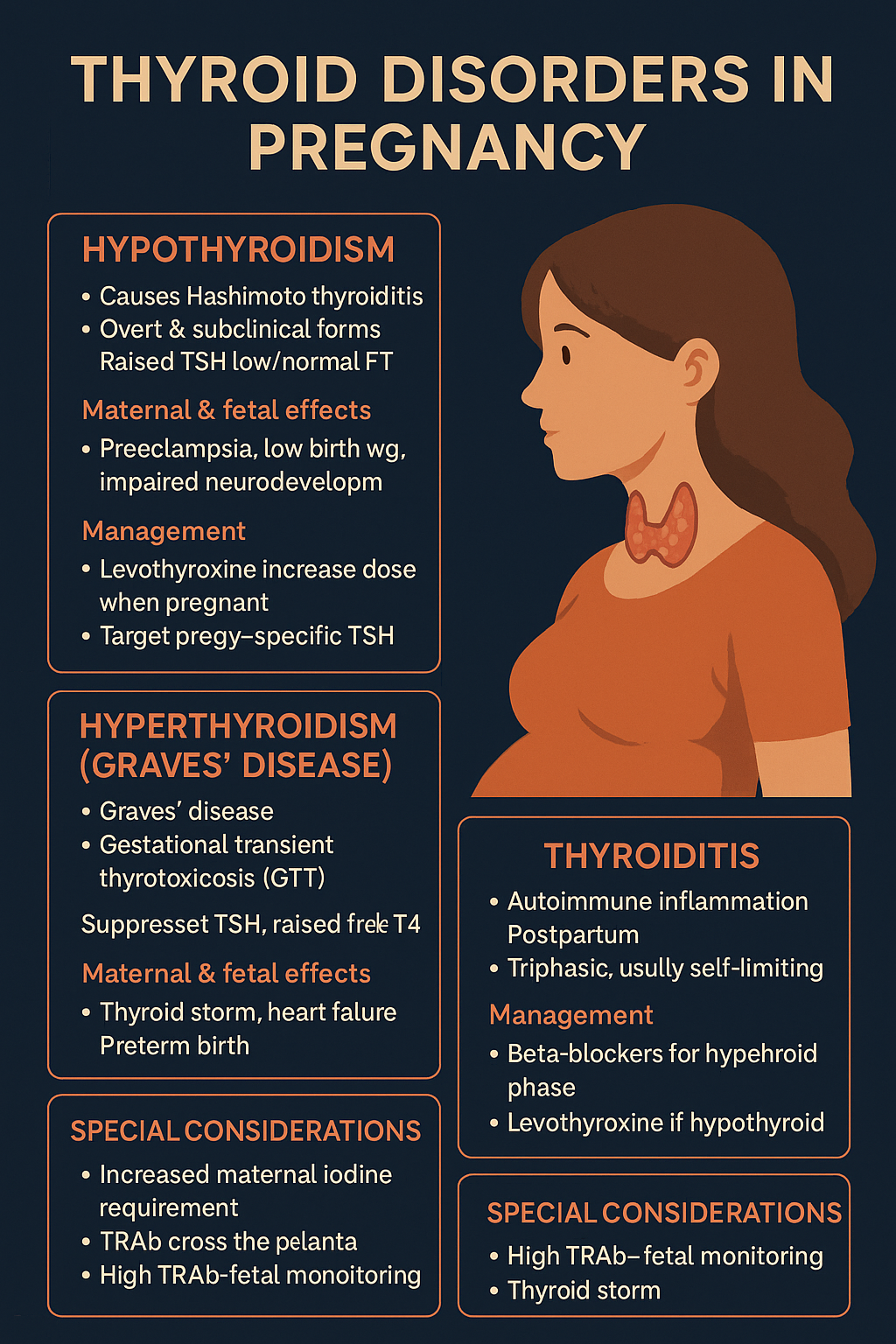
Thyroid Disorders in Pregnancy: Symptoms, Diagnosis, Risks & Treatment Guide (2025 Update)

Thyroid Disorders in Pregnancy: Symptoms, Diagnosis, Risks & Treatment Guide (2025 Update)
Below is a **complete, concise-but-exhaustive, exam-ready medical reference** for **Thyroid Disorders in Pregnancy**, covering **hypothyroidism, hyperthyroidism (Graves’), thyroiditis, and special considerations**.

---

# **Thyroid Disorders in Pregnancy — Complete Reference**

![Image](https://media.springernature.com/full/springer-static/image/art%3A10.1038%2Fs41574-021-00604-z/MediaObjects/41574_2021_604_Fig1_HTML.png?utm_source=chatgpt.com)

![Image](https://www.birthinjuryhelpcenter.org/static/2024/05/23_hyperthyroidism-womb.jpg?utm_source=chatgpt.com)

![Image](https://www.whitelotusclinic.ca/wp-content/uploads/2013/11/Thyroid-Info-1.png?utm_source=chatgpt.com)

![Image](https://media.healthdirect.org.au/images/inline/original/thyroid-gland-824103.png?utm_source=chatgpt.com)

---

# **1️⃣ Physiological Thyroid Changes in Pregnancy (Baseline Concepts)**

Understanding normal physiology is essential to interpret labs:

* ↑ **Thyroxine-binding globulin (TBG)** → ↑ total T3/T4, **free hormones unchanged**.
* **hCG stimulates TSH receptors** → mild ↑ FT4 and **↓ TSH** in 1st trimester.
* ↑ Renal iodide clearance → **↑ iodine requirement** (250 μg/day).
* Placental **D2 deiodinase** degrades maternal T4.
* TSH reference range changes:

* 1st trimester: **0.1–2.5 mIU/L**
* 2nd trimester: **0.2–3.0**
* 3rd trimester: **0.3–3.0**

---

# **2️⃣ HYPOTHYROIDISM IN PREGNANCY**

## **Definition**

Low maternal thyroid hormone levels with elevated TSH (**primary**) or low/normal TSH (**secondary**).

## **Causes**

* Hashimoto thyroiditis (most common).
* Post-radioiodine or surgery.
* Iodine deficiency.
* Drugs: amiodarone, lithium.

---

## **Clinical Features**

* Fatigue, weight gain, cold intolerance.
* Constipation, dry skin.
* Menstrual irregularities.
* **Infertility, recurrent miscarriages**.
* Severe: myxedema, heart failure.

---

## **Investigations**

* **TSH (most sensitive)**.
* **FT4** (interpret using pregnancy-specific ranges).
* **Anti-TPO antibodies** (positive in autoimmune).
* Check iron, B12 if associated anemia.

---

## **Maternal Complications**

* Miscarriage
* Anemia
* Preeclampsia
* Placental abruption
* Preterm delivery
* Postpartum hemorrhage

---

## **Fetal Complications**

* Low birth weight
* Preterm birth
* **Impaired neurocognitive development**
* Stillbirth

---

## **Management**

**Goal: Maintain TSH in trimester-specific normal range.**

### **Levothyroxine (LT4)**

* **Initial dose:**

* Newly diagnosed: 1.6 µg/kg/day.
* Already on LT4: **Increase dose by 30–50% immediately after pregnancy confirmation** (usually +2 extra tablets per week).
* **Monitoring:**

* Check TSH & FT4 every **4 weeks** in 1st/2nd trimester, then once at 30–34 weeks.
* **Drug information (LT4):**

* **Indication:** Hypothyroidism replacement.
* **Mechanism:** Synthetic T4 → converts to T3 → restores euthyroidism.
* **PK:** Absorption 70%; long half-life ~7 days; take empty stomach.
* **AE:** Palpitations, tremor (over-replacement).
* **Contraindications:** Untreated adrenal insufficiency.
* **Interactions:** Iron, calcium, PPIs ↓ absorption → separate by 4 hours.
* **Counselling:** Take daily, morning fasting; adherence crucial.

---

# **3️⃣ SUBCLINICAL HYPOTHYROIDISM**

* TSH ↑, FT4 normal.
* Treat if:

* TSH ≥ 2.5 in 1st trimester
* **TPO-positive**, or
* History of infertility, miscarriage.

**Levothyroxine same as above.**

---

# **4️⃣ HYPERTHYROIDISM IN PREGNANCY**

![Image](https://www.birthinjuryhelpcenter.org/static/2024/05/23_hyperthyroidism-womb.jpg?utm_source=chatgpt.com)

![Image](https://www.thelancet.com/cms/10.1016/S2213-8587%2813%2970086-X/asset/11a2ff1d-1f09-4e4f-b271-9c15ae788848/main.assets/gr1.jpg?utm_source=chatgpt.com)

![Image](https://images-provider.frontiersin.org/api/ipx/w%3D480%26f%3Dwebp/https%3A//www.frontiersin.org/files/Articles/258544/fendo-08-00137-HTML/image_m/fendo-08-00137-g003.jpg?utm_source=chatgpt.com)

## **Definition**

Excess thyroid hormone due to increased production (Graves’ disease) or gland destruction (thyroiditis).

---

## **Causes**

### **1. Graves’ disease (most common)**

Autoimmune stimulation by **TSH receptor antibodies (TRAb)**.

### **2. Gestational Transient Thyrotoxicosis (GTT)**

* Due to hCG stimulation
* Occurs in 1st trimester
* Mild, self-limiting
* Associated with **hyperemesis gravidarum**

---

## **Clinical Features**

* Palpitations, heat intolerance
* Weight loss
* Tremors, anxiety
* Goiter
* Ophthalmopathy (Graves’)
* Tachycardia → heart failure
* Untreated cases → **thyroid storm**

---

## **Investigations**

* TSH ↓, FT4 ↑
* **TRAb** for Graves’
* Thyroid ultrasound if nodules

---

## **Maternal Complications**

* Preeclampsia
* Thyroid storm
* Heart failure
* Miscarriage
* Infection risk (if agranulocytosis from drugs)

---

## **Fetal Complications**

* **Fetal hyperthyroidism or hypothyroidism** (due to TRAb or drugs)
* Growth restriction
* Preterm birth
* Fetal goiter
* Fetal tachycardia (>160/min)

---

## **Management**

### **1. Antithyroid Drugs (ATDs)**

**Goal: keep FT4 in high-normal range.**

#### **First trimester:**

* **Propylthiouracil (PTU)** preferred

* Lower teratogenicity vs. methimazole (MMI)
* Dose: **50–150 mg TID**

#### **Second & third trimesters:**

* Switch to **Methimazole (MMI)**

* Dose: **5–20 mg/day**

### **Drug information (ATDs)**

#### **Propylthiouracil (PTU)**

* **MOA:** inhibits TPO + peripheral T4→T3 conversion
* **AE:** hepatotoxicity, rash, agranulocytosis
* **Counselling:** Fever/sore throat → stop drug → urgent CBC.

#### **Methimazole (MMI)**

* **MOA:** inhibits TPO
* **AE:** Aplasia cutis, choanal/esophageal atresia (1st trimester), cholestasis
* **Monitoring:** FT4 every 4 weeks

---

### **2. Beta-blockers (Symptomatic control)**

* **Propranolol 10–20 mg TID** short-term (2–6 weeks)
* Avoid long-term due to fetal growth restriction.

---

### **3. Surgery**

* Indications:

* Drug intolerance
* Large goiter
* Very high TRAb
* **Timing:** **Second trimester**

---

# **5️⃣ POSTPARTUM THYROIDITIS**

* Autoimmune inflammation after delivery
* Phases:

1. Hyperthyroid (1–3 months)
2. Hypothyroid (4–6 months)
3. Recovery (1 year)

### Management

* Hyperthyroid: **Beta-blockers** only
* Hypothyroid: temporary **Levothyroxine** if symptomatic
* Recurrence in future pregnancies: **70%**

---

# **6️⃣ THYROID STORM IN PREGNANCY (EMERGENCY)**

![Image](https://www.researchgate.net/publication/309162106/figure/fig10/AS%3A668316377042951%401536350449921/An-algorithm-for-diagnostic-considerations-in-thyroid-storm-TS-thyroid-storm-ICU.png?utm_source=chatgpt.com)

![Image](https://biomedpharmajournal.org/wp-content/uploads/2018/08/Vol11No3_Dia_Adi_fig3.jpg?utm_source=chatgpt.com)

## **Features**

* Fever, tachycardia, vomiting
* Delirium, heart failure
* Precipitated by labor, infection, surgery

## **Management Protocol**

1. **PTU 600–1000 mg loading dose**, then 200–300 mg Q6h
2. **Iodine solution** after 1 hour
3. **Propranolol** IV/oral
4. **Hydrocortisone 100 mg IV Q8h**
5. Treat precipitating cause
6. ICU care

---

# **7️⃣ MONITORING SUMMARY**

| Disorder | Follow-up |
| ----------------------- | ---------------------------------------------------- |
| Hypothyroidism | TSH every 4 weeks |
| Hyperthyroidism on ATDs | FT4 every 4 weeks |
| TRAb-positive Graves’ | TRAb at 24–28 weeks, fetal US for tachycardia/goiter |
| Postpartum | Re-check thyroid at 6 weeks postpartum |

---

# **8️⃣ FETAL SURVEILLANCE**

* Fetal heart rate (tachycardia → hyperthyroid)
* Fetal goiter on ultrasound
* Growth assessment
* Amniotic fluid volume
* Doppler if growth restriction suspected

---

# **9️⃣ KEY DIFFERENTIATION TABLE**

| Condition | TSH | FT4 | TRAb | Treatment |
| ----------- | --- | ------ | ------------ | ------------- |
| Graves’ | ↓ | ↑ | ↑ | PTU → MMI |
| GTT | ↓ | Mild ↑ | Normal | Supportive |
| Hypothyroid | ↑ | ↓ | TPO+ | Levothyroxine |
| Subclinical | ↑ | Normal | TPO variable | Treat if TPO+ |

---

# **Would you like an SEO title, description, keywords, or an infographic for this topic?**

HTML Versions