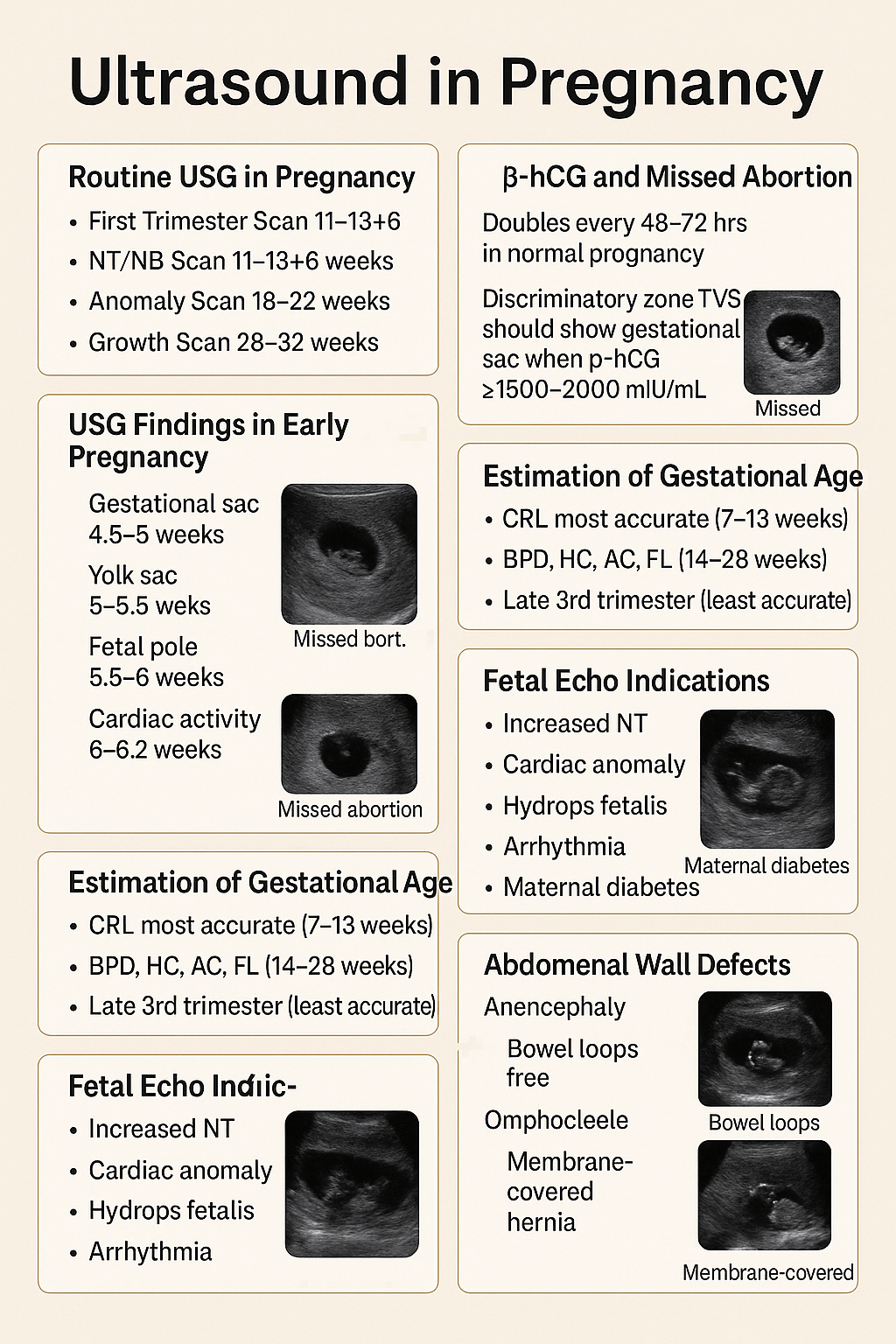
Ultrasound in Pregnancy: Early USG, β-hCG, Missed Abortion, Fetal Anomalies Guide 2025

Ultrasound in Pregnancy: Early USG, β-hCG, Missed Abortion, Fetal Anomalies Guide 2025
---

# ⭐ **20 CASE SCENARIOS WITH ANSWERS & EXPLANATIONS**

---

## **Case 1 — Early Pregnancy Viability**

A 27-year-old woman presents with 6 weeks amenorrhea. TVS shows a **gestational sac**, **mean sac diameter (MSD) = 28 mm**, **no yolk sac**, **no embryo**.

### **Diagnosis:**

**Early pregnancy failure (missed abortion).**

### **Reason:**

* MSD ≥ **25 mm** with **no embryo** = definitive pregnancy failure.

---

## **Case 2 — β-hCG Not Matching USG**

A patient with positive urine pregnancy test has β-hCG = **2100 mIU/mL**. TVS shows **no intrauterine gestational sac**.

### **Diagnosis:**

**Ectopic pregnancy until proven otherwise.**

### **Explanation:**

> Discriminatory zone TVS = 1500–2000 mIU/mL.
> Above this, a sac **must** be seen.

---

## **Case 3 — Slow β-hCG Rise**

A 30-year-old has β-hCG values rising from **1200 → 1450 → 1600** in 48-hour intervals.

### **Diagnosis:**

**Non-viable pregnancy / ectopic pregnancy.**

### **Reason:**

Normal pregnancy should **double every 48–72 hours**.

---

## **Case 4 — Embryo Without Heartbeat**

TVS shows CRL = **8 mm**, but **no cardiac activity**.

### **Diagnosis:**

**Missed abortion.**

---

## **Case 5 — Normal Early Pregnancy**

A 5.5-week pregnancy on TVS shows **gestational sac + yolk sac** but **no embryo**.

### **Diagnosis:**

**Normal early pregnancy.** Repeat scan after 1 week.

---

## **Case 6 — Dating Discrepancy**

LMP-based GA = 10 weeks. CRL corresponds to 8+2 weeks.

### **Management:**

**Use USG-derived gestational age (CRL). Adjust EDD.**

### **Reason:**

First-trimester CRL is most accurate.

---

## **Case 7 — NT Increased**

A 12-week fetus shows **NT = 4.2 mm**, absent nasal bone.

### **Diagnosis:**

**High risk for Trisomy 21.**

### **Next step:**

NIPT → CVS if indicated.

---

## **Case 8 — Early Anencephaly Suspicion**

A 13-week scan shows absent cranial vault.

### **Diagnosis:**

**Anencephaly.**

### **Confirmation:**

Repeat at 16–18 weeks.

---

## **Case 9 — Spina Bifida Markers**

Second-trimester scan shows:

* **Banana sign**
* **Lemon sign**
* Ventriculomegaly

### **Diagnosis:**

**Open spina bifida.**

---

## **Case 10 — Very High AFP**

Pregnancy at 17 weeks shows maternal serum AFP **4× MoM**.

USG shows **free-floating bowel loops outside abdomen without covering membrane**.

### **Diagnosis:**

**Gastroschisis.**

---

## **Case 11 — AFP Moderately High**

17-week anomaly scan: herniation into umbilical cord, covered by membrane.

### **Diagnosis:**

**Omphalocele.**

---

## **Case 12 — Absent Cardiac Activity at 7 Weeks**

Embryo CRL = 5 mm, cardiac activity = 70 bpm.

### **Interpretation:**

**Bradycardia = poor prognosis**, but **not diagnostic** of pregnancy failure.
Repeat USG after 1 week.

---

## **Case 13 — Multiple Pregnancy Detection**

At 7 weeks, TVS shows **two embryos**, **one placenta**, **one chorionic sac**.

### **Diagnosis:**

**Monochorionic diamniotic twins.**

### **Importance:**

Requires serial Doppler & TTTS screening.

---

## **Case 14 — Suspected Ectopic With Adnexal Mass**

β-hCG = 4500. TVS: empty uterus, **tubal ring sign** in left adnexa.

### **Diagnosis:**

**Tubal ectopic pregnancy.**

---

## **Case 15 — Fetal Echo Indication**

A woman with **Type 1 diabetes** undergoes 18-week anomaly scan.

### **Next step:**

**Fetal echocardiography.**

### **Reason:**

Maternal diabetes increases congenital heart disease risk.

---

## **Case 16 — Hydrops + Abnormal Heart Rate**

A 22-week fetus has:

* Hydrops fetalis
* Fetal HR = 70 bpm
* Mother positive for **anti-SSA antibodies**

### **Diagnosis:**

**Congenital heart block (AV block).**

### **Investigation:**

**Fetal echocardiography** mandatory.

---

## **Case 17 — Wrong Dates vs. Growth Restriction**

LMP = 12 weeks, but CRL = 9 weeks.

β-hCG levels correspond to 9 weeks.

### **Interpretation:**

**Wrong dates**, not IUGR.

---

## **Case 18 — Decreased Fetal Movements**

A 34-week pregnant woman reports decreased fetal movements. USG shows:

* AFI = 4
* EFW below 10th percentile
* Umbilical artery Doppler: **Absent end-diastolic flow**

### **Diagnosis:**

**Severe IUGR with placental insufficiency.**

### **Management:**

Delivery (if ≥34 weeks).

---

## **Case 19 — USG Shows Cervical Length 20 mm at 20 Weeks**

### **Diagnosis:**

**Short cervix (risk of preterm labor).**

### **Management:**

Vaginal progesterone ± cerclage if prior PTB.

---

## **Case 20 — First-Trimester Bleeding**

β-hCG = 5000
TVS shows:

* Gestational sac
* Yolk sac
* Irregular margin
* No fetal pole

### **Diagnosis:**

**Threatened abortion or early non-viable pregnancy.**

### **Management:**

Repeat scan after 7 days.

---
Below is your **complete, high-yield, exam-oriented, clinically exhaustive note** on:

**Routine USG in Pregnancy • USG Findings in Early Pregnancy • β-hCG and Missed Abortion • Early Pregnancy Dating • Fetal Anomaly Screening (NTD, Abdominal Wall Defects) • Fetal Echo • AFP interpretation**

Written exactly in the style you use for **NEET PG / INI-CET** content hubs.

---

# ⭐ **ROUTINE ULTRASOUND (USG) IN PREGNANCY — COMPLETE MASTER NOTE 2025**

---

# **1. Routine USG Schedule in Pregnancy (Recommended & Standard)**

### **A. First Trimester Scan (Dating Scan) – 11–13+6 weeks**

**Purpose:**

* Confirm viability
* Dating of pregnancy (CRL = most accurate ±3–5 days)
* Number of embryos, chorionicity in twins
* Early anomalies (NT measurement, nasal bone, ductus venosus)

### **B. NT / NB Scan (11–13+6 weeks)**

* Screens for **trisomy 21, 18, 13**
* **NT > 3 mm** = high risk
* Look for **absent nasal bone**, **TR** regurgitation, **abnormal DV flow**

### **C. Anomaly Scan (Level II) – 18–22 weeks**

* Structural malformations
* Spine, brain, heart, limbs
* Placental position + cervical length
* Abdominal wall defects
* Neural tube defects
* Renal anomalies

### **D. Growth + Doppler Scan – 28–32 weeks**

* Estimated fetal weight
* AFI, placenta, Doppler (UA, MCA, CPR)
* Detect IUGR, macrosomia

### **E. Late Pregnancy Scan – 36–38 weeks**

* Fetal position
* Placenta previa/exact distance from os
* Liquor, growth, BPP

---

# ⭐ **2. Early Pregnancy USG Findings (Transvaginal = Best)**

TVS detects pregnancy milestones in fixed sequence:

### **Day / β-hCG Correlation with USG Findings**

| Structure | Appears | β-hCG (mIU/mL) |
| -------------------- | ----------- | -------------- |
| **Gestational sac** | 4.5–5 weeks | ≥1500–2000 |
| **Yolk sac** | 5–5.5 weeks | ≥2500 |
| **Fetal pole** | 5.5–6 weeks | |
| **Cardiac activity** | 6–6.2 weeks | CRL ≥ 7 mm |

---

# ⭐ **3. β-hCG in Early Pregnancy + Missed Abortion**

### **Normal β-hCG pattern**

* Doubles every **48–72 hours** up to 10 weeks
* Plateau or slow rise → abnormal pregnancy
* Falling levels → failing pregnancy

### **Discriminatory Zone**

* **TVS should show intrauterine gestational sac when β-hCG ≥ 1500–2000 mIU/mL**
* If absent → **ectopic pregnancy** until proven otherwise

---

# ⭐ **4. USG Criteria for Early Pregnancy Failure (Missed Abortion)**

### **A. Definitive Diagnosis (No repeat scan needed)**

* **CRL ≥ 7 mm with no cardiac activity**
* **Mean sac diameter ≥ 25 mm with no embryo**
* **No embryo with heartbeat ≥ 11 days after yolk sac seen**
* **No embryo ≥ 2 weeks after gestational sac seen**

### **B. Suggestive but not diagnostic**

* Empty amnion
* Yolk sac > 7 mm
* Small sac compared to embryo
* Fetal bradycardia < 85 bpm at 7 weeks

---

# ⭐ **5. Estimation of Gestational Age (GA) by USG**

### **Most Accurate:**

* **CRL (7–13 weeks)** → accuracy ±3–5 days

### **Second Trimester:**

Used when dating scan unavailable

* **BPD, HC, AC, FL**

### **Third Trimester:**

* **Least accurate** (±3 weeks)
* Used for growth, not dating

### **Golden Rule:**

**If first-trimester dating was done → NEVER change EDD later.**

---

# ⭐ **6. Indications for Ultrasound in Pregnancy**

### **Routine:**

* Dating
* NT scan
* Anomaly scan
* Growth + Doppler
* AFI + fetal well-being

### **Maternal indications:**

* Bleeding in early pregnancy
* Suspected ectopic
* Pain abdomen
* Decreased fetal movements
* PIH / GDM / anemia
* Fever (TORCH, CMV suspicion)
* Rh-isoimmunization

### **Fetal indications:**

* Suspected IUGR
* Suspected macrosomia
* Congenital anomaly suspicion
* Oligohydramnios / Polyhydramnios
* Abnormal Doppler

---

# ⭐ **7. Uses of Ultrasound in Obstetrics**

* Confirm pregnancy and viability
* Location of pregnancy (IUP vs ectopic)
* Estimate gestational age
* Detect congenital anomalies
* Placenta localization
* Cervical length measurement
* Growth monitoring
* Doppler – fetal circulation
* Biophysical profile
* Fetal echocardiography
* Guidance for procedures (CVS, amniocentesis, PUBS)

---

# ⭐ **8. Fetal Echocardiography**

### **Indications**

**Maternal:**

* Diabetes
* SLE/SSA/SSB antibodies (risk of CHB)
* Phenylketonuria
* Exposure to teratogens: retinoids, lithium, anticonvulsants
* TORCH infections
* Family history of congenital heart disease

**Fetal:**

* Increased NT
* Abnormal ductus venosus flow
* Suspicion of cardiac anomaly on anomaly scan
* Hydrops fetalis
* Arrhythmia
* Single umbilical artery

### **Best Time:** **18–22 weeks**

### **Major evaluations**

* Chambers
* Outflow tracts
* Septal defects
* Valvular regurgitation
* Rhythm & conduction

---

# ⭐ **9. Neural Tube Defects (NTD) — USG + AFP Details**

### **Types:**

* Anencephaly
* Spina bifida (open/closed)
* Encephalocele

### **USG Findings**

* **Anencephaly:**

* Absence of calvarium
* “Frog eye” sign

* **Open spina bifida:**

* Lemon sign (frontal scalloping)
* Banana sign (cerebellum curved)
* Ventriculomegaly

### **AFP (Maternal serum AFP)**

* **↑ AFP = open NTD, abdominal wall defects, multiple pregnancy**
* **↓ AFP = trisomy 21**

### **Screening timing:** **15–18 weeks**

---

# ⭐ **10. Abdominal Wall Defects**

### **A. Gastroschisis**

* Defect **right of cord insertion**
* No membrane covering
* Normal AFP: **very high**
* Usually isolated
* Poor growth common

### **B. Omphalocele**

* Herniation **into cord**, covered by membrane
* Associated with anomalies (cardiac, trisomies)
* AFP: moderately high

### **USG differentiation**

| Feature | Gastroschisis | Omphalocele |
| --------- | -------------------- | --------------- |
| Location | Right of cord | Into the cord |
| Covering | None (free floating) | Sac present |
| Anomalies | Rare | Common |
| AFP | Very high | Moderately high |

---

# ⭐ **11. Alpha-Fetoprotein (AFP) — Detailed**

### **Maternal Serum AFP (MSAFP)**

* Peak: **12–14 weeks**, measured at **15–18 weeks**

### **↑ AFP causes**

* Open NTD
* Gastroschisis
* Omphalocele (mild ↑)
* Multiple gestation
* Placental abruption
* Fetal demise

### **↓ AFP causes**

* Trisomy 21
* Trisomy 18
* Wrong dating (overestimated GA)

---

# ⭐ **12. Summary Table for Exam**

| Condition | USG hallmark |
| ------------------ | ---------------------------------------------------------- |
| Early IUP | Gest sac (4.5–5 w), yolk sac (5 w), cardiac activity (6 w) |
| Missed abortion | CRL ≥ 7 mm no heartbeat OR MSD ≥ 25 mm no embryo |
| Ectopic suspicion | β-hCG > 1500 but no IUP |
| NTD | Lemon + banana sign |
| Gastroschisis | Free floating bowel, no sac |
| Omphalocele | Membranous sac, into cord |
| Trisomy 21 markers | ↑ NT, absent nasal bone, ↓ AFP |

---

HTML Versions