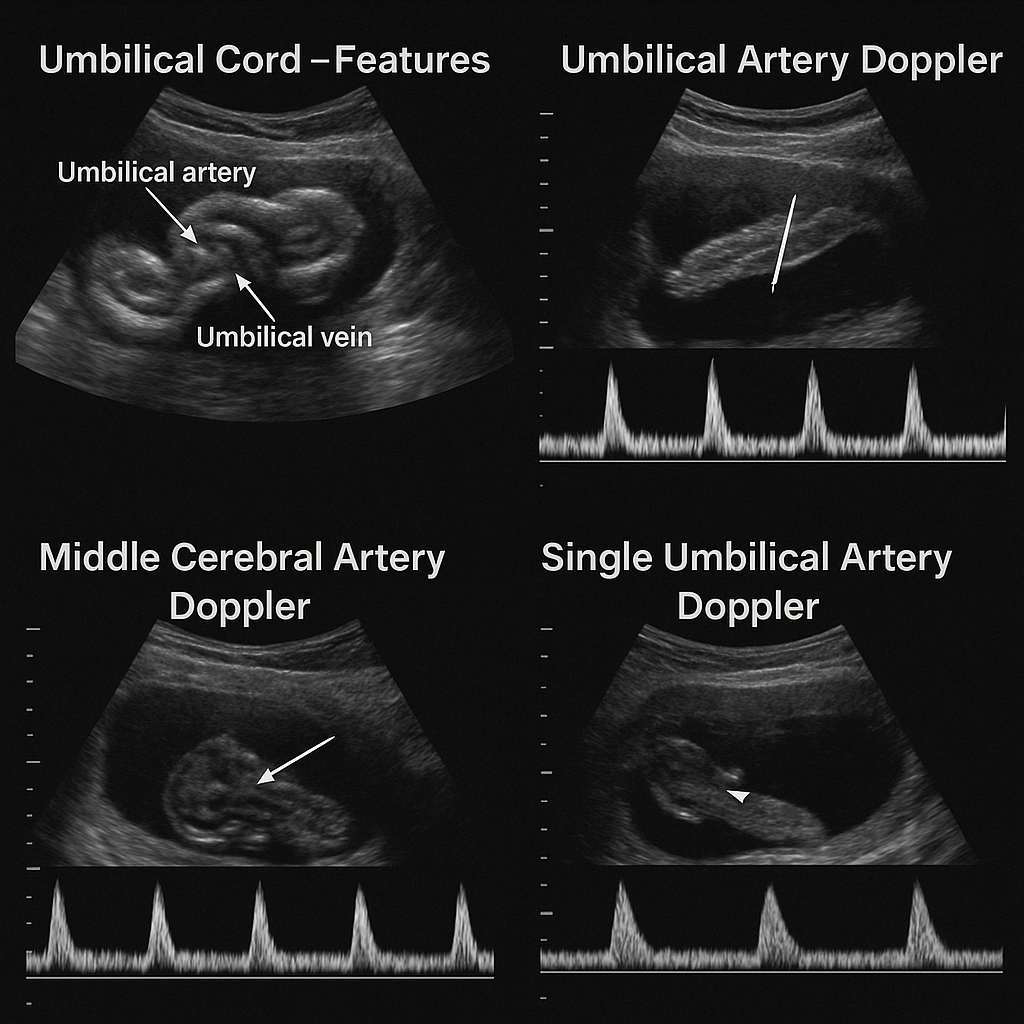
Umbilical Cord Features, UA & MCA Doppler, Single Umbilical Artery | Complete Obstetrics Doppler Guide 2025

Umbilical Cord Features, UA & MCA Doppler, Single Umbilical Artery | Complete Obstetrics Doppler Guide 2025
---

# ⭐ **20 CASE SCENARIOS WITH DETAILED MANAGEMENT**

---

## **1️⃣ CASE: AEDF on Umbilical Artery Doppler**

A 30-year-old woman at 32 weeks with severe IUGR. UA Doppler shows **absent end-diastolic flow (AEDF)**.

### **Diagnosis:** Severe placental insufficiency.

### **Management:**

* Admit immediately
* Daily NST + BPP
* Give **Betamethasone** if <34 wks
* Deliver if:

* Worsening Doppler
* Nonreassuring CTG
* **Preferred delivery:** C-section

---

## **2️⃣ CASE: REDF in Umbilical Artery**

29-year-old gravida 2 at 30 weeks. UA Doppler: **Reversed end-diastolic flow (REDF)**.

### **Diagnosis:** Critical placental resistance (pre-terminal Doppler).

### **Management:**

* Urgent admission
* Antenatal corticosteroids
* Magnesium sulfate if <32 wks
* **Immediate delivery** (usually C-section)
* Continuous fetal monitoring

---

## **3️⃣ CASE: Elevated MCA-PSV (1.7 MoM)**

Rh-negative mother at 28 weeks; MCA Doppler shows **PSV 1.7 MoM**.

### **Diagnosis:** Fetal anemia.

### **Management:**

* Perform **Middle Cerebral Artery PSV trending**
* Do an **ultrasound for hydrops**
* Arrange **cordocentesis**
* **Intrauterine transfusion (IUT)** if Hb deficit >7 g/dL
* Weekly MCA Doppler after IUT

---

## **4️⃣ CASE: MCA PI Low with High UA PI**

Patient at 34 weeks with IUGR. UA PI ↑, MCA PI ↓ → **Low CPR (<1)**.

### **Diagnosis:** Brain-sparing / fetal hypoxia.

### **Management:**

* Deliver at **37 weeks** if stable
* If NST abnormal → **immediate delivery**
* Avoid labor induction if fetal reserve poor

---

## **5️⃣ CASE: Isolated Single Umbilical Artery**

At 20-week anomaly scan, SUA found but no other defects.

### **Diagnosis:** Isolated SUA.

### **Management:**

* Detailed anomaly scan
* Fetal echo
* Growth scan every 4 weeks
* Normal delivery if growth normal
* Reassure: good prognosis

---

## **6️⃣ CASE: SUA With Renal Agenesis**

SUA + unilateral renal agenesis on scan.

### **Diagnosis:** Non-isolated SUA.

### **Management:**

* Fetal echo
* Karyotyping / NIPT
* Serial Dopplers
* Delivery based on growth
* Neonatal renal evaluation after birth

---

## **7️⃣ CASE: Cord Around Neck (Nuchal Cord x2)**

Fetus at 39 weeks with **two loops** of nuchal cord.

### **Diagnosis:** Nuchal cord with possible variable decelerations.

### **Management:**

* Intrapartum CTG monitoring
* If recurrent decels → C-section
* Otherwise trial of labor acceptable
* Avoid fundal pressure

---

## **8️⃣ CASE: Marginal Cord Insertion**

31-week scan shows marginal insertion.

### **Management:**

* Growth scans every 4 weeks
* If IUGR → add UA/MCA Dopplers
* Delivery at term unless growth restricted

---

## **9️⃣ CASE: Velamentous Cord Insertion**

Scan shows vessels running through membranes (velamentous insertion).

### **Management:**

* Rule out **vasa previa**
* Serial growth scans
* Elective C-section at 36–37 wk if vasa previa
* If not, vaginal delivery with continuous monitoring

---

## **🔟 CASE: True Knot of Cord**

Detected on 3D ultrasound; fetus active.

### **Management:**

* Weekly NST
* Biweekly Dopplers
* Deliver at 37–38 weeks
* Emergency C-section if signs of distress

---

## **1️⃣1️⃣ CASE: IUGR With Normal Doppler**

Estimated fetal weight <10th centile; UA, MCA normal.

### **Diagnosis:** Constitutionally small baby.

### **Management:**

* Growth every 2 wks
* Deliver at 38–39 weeks
* Good prognosis

---

## **1️⃣2️⃣ CASE: Cord Prolapse**

During labor, visible cord prolapse after ROM.

### **Management:**

* Lift presenting part manually
* Trendelenburg or knee-chest position
* Emergency C-section
* Avoid handling cord continuously

---

## **1️⃣3️⃣ CASE: Positive Contraction Stress Test + Abnormal UA**

Mother at 38 weeks, CST positive, UA PI high.

### **Diagnosis:** Uteroplacental insufficiency.

### **Management:**

* **Immediate delivery** (prefer C-section)
* Avoid induction due to fetal intolerance

---

## **1️⃣4️⃣ CASE: MCA Doppler Suggesting Hypoxia**

MCA PI <5th percentile; UA PI normal.

### **Diagnosis:** Early fetal hypoxia.

### **Management:**

* Twice weekly NST
* Delivery at 37 weeks
* If CTG abnormal → emergency delivery

---

## **1️⃣5️⃣ CASE: Cord Hematoma**

Ultrasound shows a mass along the cord with absent flow.

### **Management:**

* Immediate fetal assessment (BPP, CTG)
* If non-reassuring → emergency C-section
* If stable → frequent monitoring until term

---

## **1️⃣6️⃣ CASE: Short Umbilical Cord (<35 cm)**

Noted during scan; fetus has decreased movements.

### **Management:**

* Evaluate for fetal anomalies
* Growth monitoring
* Prepare for labor complications:

* Abruption
* Uterine inversion
* Active management of third stage

---

## **1️⃣7️⃣ CASE: Long Umbilical Cord (>70 cm)**

Detected with polyhydramnios + hyperactive fetus.

### **Management:**

* Monitor for cord knots
* Weekly NST
* Induce labor at 39 weeks
* Emergency C-section if fetal distress

---

## **1️⃣8️⃣ CASE: Fetal Bradycardia After ROM**

Cord compression suspected.

### **Management:**

* Reposition mother
* Oxygen supplementation
* Tocolytics (terbutaline)
* If unresolved → emergency C-section

---

## **1️⃣9️⃣ CASE: IUGR with Abnormal UA but Normal MCA**

UA PI ↑; MCA normal (no brain-sparing yet).

### **Diagnosis:** Early-stage placental insufficiency.

### **Management:**

* Twice-weekly NST
* Weekly Dopplers
* Deliver at 37 weeks unless worsening

---

## **2️⃣0️⃣ CASE: Preterm Pregnancy With Severe Doppler Abnormalities**

UA: AEDF; MCA: Low PI; CPR <1 at 28 weeks.

### **Diagnosis:** Advanced fetal hypoxia (pre-acidosis).

### **Management:**

* Hospitalize
* Betamethasone
* Magnesium sulfate (<32 wks)
* Daily CTG
* Deliver when:

* BPP ≤4
* CTG nonreassuring
* Method: **C-section**

---

Below is your **complete, exam-oriented, high-yield but exhaustive reference** on the **umbilical cord features, Umbilical Artery Doppler, Middle Cerebral Artery (MCA) Doppler, and Single Umbilical Artery (SUA)** — structured exactly in NEET PG / INI-CET style.

---

# ⭐ **UMBILICAL CORD – FEATURES (Detailed Note)**

### **1. Basic Structure**

* Normally **2 arteries + 1 vein** (AVA).
* **Umbilical vein**: carries **oxygenated blood from placenta → fetus**.
* **Two umbilical arteries**: carry **deoxygenated blood from fetus → placenta**.
* Surrounded by **Wharton’s jelly** – protects vessels, prevents compression.
* Length: **50–60 cm** (range: 30–100 cm).
* Diameter: **1.5–2 cm**.
* Spiral pattern: usually **right-handed twist** (5–20 spirals).
* Insertion:

* **Central** (most common)
* **Eccentric**
* **Marginal (Battledore)**
* **Velamentous** → vessels traverse membranes → **risk of vasa previa & fetal bleeding**.

### **2. Abnormal Length**

* **Short cord (<35 cm)**

* Causes: Oligohydramnios, fetal anomalies, fetal distress
* Complications: Abruption, cord rupture, difficulty in descent, uterine inversion
* **Long cord (>70 cm)**

* Complications: Cord knots, cord prolapse, nuchal cord, fetal distress

### **3. Cord Abnormalities**

* **True knot** → risk of stillbirth
* **False knot** (redundant vessels; harmless)
* **Nuchal cord** (cord around neck)
* **Cord hematoma**
* **Velamentous insertion**
* **Marginal insertion**

---

# ⭐ **UMBILICAL ARTERY (UA) DOPPLER – DETAILED NOTE**

Umbilical artery Doppler assesses **fetoplacental circulation** and is essential in **IUGR evaluation**.

### **1. What UA Doppler Measures**

* **Systolic/Diastolic ratio (S/D ratio)**
* **Pulsatility Index (PI)**
* **Resistance Index (RI)**

Normal pregnancy → **progressively decreasing placental resistance**, so **diastolic flow increases**.

---

### **2. Abnormal UA Doppler Findings**

| Finding | Meaning | Clinical Significance |
| --------------------------------------------- | --------------------------- | ----------------------------- |
| **Raised S/D ratio, PI, RI** | ↑ placental resistance | Early placental insufficiency |
| **Absent End-Diastolic Flow (AEDF / AEDV)** | Severe placental resistance | High risk perinatal mortality |
| **Reversed End-Diastolic Flow (REDF / REDV)** | Blood flows backward | *Impending fetal demise* |

---

### **3. Interpretation & Management**

* **Abnormal PI/RI** → Growth restriction → increase surveillance (NST, BPP, MCA Doppler).
* **AEDF** → Admit mother, daily fetal monitoring, steroids if preterm. Deliver based on gestation & overall status.
* **REDF** → Consider **urgent delivery** (usually >28–30 weeks).
* UA Doppler is the **best test for fetoplacental insufficiency**.

---

# ⭐ **MIDDLE CEREBRAL ARTERY (MCA) DOPPLER – DETAILED NOTE**

MCA Doppler evaluates **fetal cerebral circulation** → important in **fetal anemia** and **brain-sparing effect in IUGR**.

---

### **1. What MCA Doppler Measures**

* **Peak Systolic Velocity (PSV)**
* **MCA-PI (Pulsatility Index)**

---

### **2. Normal Pattern**

* Normally **high resistance** vessel → lower diastolic flow.
* MCA-PI **decreases with advancing gestation** slowly.

---

### **3. Abnormal Findings**

| Finding | Meaning | Clinical Importance |
| ------------------------ | ------------------------ | --------------------------------------------------------------- |
| **↑ MCA-PSV (>1.5 MoM)** | **Fetal anemia** | Seen in Rh isoimmunization, parvovirus, fetomaternal hemorrhage |
| **↓ MCA-PI** | **Brain-sparing effect** | Seen in severe IUGR, fetal hypoxia |

---

### **4. Brain-Sparing Effect**

* When fetus is hypoxic, it causes:

* **Vasodilation of MCA** → ↓ PI
* Preferential blood flow to brain
* Indicates **compensated state** before fetal acidosis.

---

### **5. Clinical Uses**

* **Diagnosing fetal anemia** (most sensitive noninvasive test).
* **Monitoring Rh isoimmunization**.
* Correlating severity of **IUGR** with UA Doppler findings.

---

# ⭐ **CEREBROPLACENTAL RATIO (CPR)**

CPR = **MCA-PI / Umbilical Artery PI**

* **Normal > 1.0**
* **Low CPR (<1)** → poor prognosis, predicts fetal distress & intrapartum hypoxia.

---

# ⭐ **SINGLE UMBILICAL ARTERY (SUA) – DETAILED NOTE**

### **1. Definition**

SUA = presence of **only one artery + one vein** in cord (instead of AVA).

Incidence: **0.5–1%** of singleton pregnancies.

---

### **2. Causes & Associations**

* Abnormal regression of one artery
* Associated with:

* **Renal anomalies** (most common)
* Cardiac defects
* GI anomalies
* Trisomies 13, 18
* IUGR
* Preterm birth

---

### **3. Types**

* **Isolated SUA** → usually good prognosis
* **Non-isolated SUA** → associated anomalies → poor prognosis

---

### **4. Ultrasound / Doppler Appearance**

* Only one artery visible around bladder in **transverse view**.
* UA Doppler may show **increased resistance**.

---

### **5. Management**

* Detailed anomaly scan
* Fetal echocardiography
* Serial growth scans every 4 weeks
* If isolated SUA → good outcome expected
* Delivery based on fetal growth & Dopplers

---

# ⭐ **SUMMARY TABLE**

| Parameter | Umbilical Artery Doppler | MCA Doppler | SUA |
| --------------- | ------------------------ | ------------------------------------ | --------------------------- |
| Assesses | Placental resistance | Cerebral perfusion | Cord structural abnormality |
| Key abnormality | AEDF / REDF | ↑ PSV (anemia), ↓ PI (brain-sparing) | 1 artery only |
| Best use | IUGR severity | Fetal anemia | Anomaly screening |
| Danger sign | REDF | PSV >1.5 MoM | Non-isolated SUA |

---

HTML Versions